.do Domain: The Country Extension of the Dominican Republic
.do is the country code top-level domain of the Dominican Republic and entered the root zone on 25 August 1991. The organisation that runs the zone is neither a company nor a government agency but a university: the NIC .DO office inside the Pontificia Universidad Católica Madre y Maestra. The registry accepts no applications directly; you register through an accredited registrar, and requests are queued on a first come, first served basis. Registering straight at the second level is far more recent, though: a short name in the form example.do has only been possible since December 2009.
On eligibility .do is a wide door: individuals and companies alike may register, whether or not they are established in the Dominican Republic, and there is no local address, agent or paperwork requirement. The only classifications that ask for documents are the ones reserved for public and military bodies. Most established local brands still sit one level lower, under .com.do, and because the registry governs the two levels separately you can hold the same name at both. Choose .do for a short, memorable address and .com.do for settled commercial identity.
Two details bear directly on your order. The first is what happens after expiry: the name is switched off at once, a 30-day suspension runs first, a 15-day redemption window follows, and on day 45 the name opens to everyone — throughout that stretch your site and mail are offline. The second is transfer: a change of registrar carries an automatic one-year renewal with it, so moving provider actually extends your term. Check whether the name you want is free on the domain name search page.
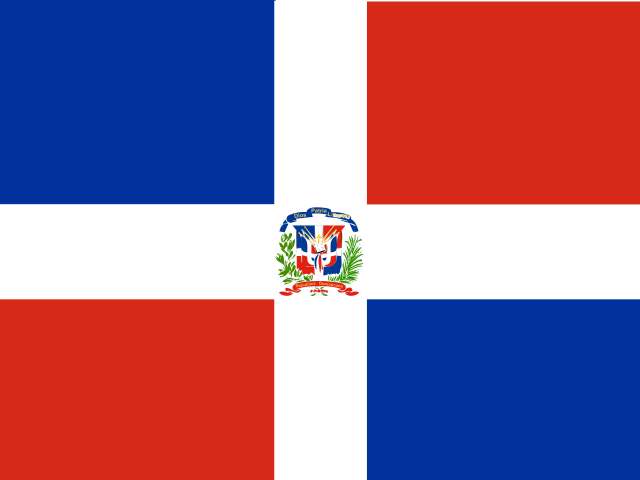
.DO Domain at a Glance
- Registry operator NIC .DO — Pontificia Universidad Católica Madre y Maestra
- Entered the root zone 25 August 1991
- Second-level registration Open since December 2009
- After expiry 30 days suspended, then 15 days redemption
- Dispute forum WIPO Arbitration and Mediation Center
- Rules in force NIC .DO Delegation Policy, last amended May 2017
- Document Requirement No documents are required to register a .do domain
- Country Dominican Republic
- Character Length 3 - 63 characters
- Registration Period 1 - 10 years
- Name Server Count 2 - 10 servers
.do Domain Prices — No Surprise Fees
Registration, transfer and renewal fees are listed separately. The renewal price can differ from the first-year price, so you see both up front.
-
New Registration
$115.00 /year -
Transfer
$115.00 /year -
Renewal
$126.50 /year
Included With Every .do Domain
-
Free DNS management
Change A, MX, TXT and CNAME records yourself from the panel — no waiting on anyone when you move a site or mailbox.
-
Domain forwarding
Point the domain at your existing site, a campaign page or a social profile — at no extra cost.
-
Free WHOIS privacy
Your name, address and phone stay out of public WHOIS records, which cuts down spam and scam calls.
.do Domain Lifecycle
What happens day by day after it expires
Day 0 is the domain's expiry dateIn short: for .do the post-expiry timeline is set by the registry, so it differs from one extension to the next. The diagram below shows the windows that actually apply to .do, day by day. One thing never changes, whichever extension you hold: renewing before the expiry date is always the cheapest and safest route.
Domain Is Available (Available)
A .do address at this stage has not been taken yet, and it goes to whoever registers first. Check the name you have in mind — if it is free, it can be yours within minutes.
Domain Is Active (Active Period)
Once registration is complete, the domain is registered to you for the term you selected. You can renew at any point before it expires to keep it active, or switch on auto-renewal so you never have to watch the date.
Redemption Period (Redemption Period)
The domain is not released the moment it expires — during this window it is still yours and can be recovered. Some extensions charge an extra restore fee at this stage, so renewing before expiry is always the cheaper route.
Domain Is Available Again
Once deletion completes, the domain leaves the system and anyone can register it — popular names are often taken the same minute by someone watching. Keep auto-renewal on so a name you care about never gets this far.
.do Domain Specifications and Registration Rules
Registration conditions, supported features and the registry's own timelines in a single table.
.do Domain Registration
- Document Requirement No documents are required to register a .do domain
- Country Dominican Republic
- Character Length 3 - 63 characters
- Registration Period 1 - 10 years
- Name Server Count 2 - 10 servers
.do Domain Support
- IDN Support No
- Transfer Support Yes
- Late Renewal Support No
Frequently Asked Questions About .do Domains
The questions people actually ask before registering — answered plainly.
-
No. The registry's policy defines the applicant as any «natural or legal person» and nowhere asks for residence, a company, a tax number or a local contact in the Dominican Republic. A business registered in Türkiye, a sole trader and a private individual all register on the same terms. In the registry's own classification table the .do row reads «any sector or person» and the additional-requirements column is empty. The only extensions that ask for documents are those reserved for public and military bodies, and they run through a separate portal. What the registry does insist on is data: incomplete or outdated contact details are grounds for suspension.
-
From one year up to ten. The policy sets the term at «a minimum period of one (1) year and a maximum of ten (10) years» and places no restriction on the values in between, so two, three or five years are equally valid. Renewal must be filed by the expiry date at the latest — recovery afterwards is a separate, chargeable procedure. There is a second way the term grows: a change of registrar carries an automatic one-year renewal under the rules, so switching provider pushes your expiry date forward. Longer terms are popular with corporate projects because they cut renewal admin and remove the risk of an accidental lapse.
-
The registry's policy sets the minimum at two characters for the second level, dropping to one character at the third level. The ceiling is sixty-three characters in both cases. A single-letter or single-digit .do name cannot be had: the registry's lookup does not report such names as available but rejects them outright as not allowed under registry policy. Two-character names, by contrast, are genuinely registered and have been in use for years. With short names, mind the hyphen rule as well: a hyphen may not open or close the name, and it cannot occupy the third and fourth positions at the same time.
-
Forty-five days in total. After the expiry date the name first enters a 30-day suspension; it is still yours but it stops resolving — the site does not load and mail does not arrive. If you do not renew within that window the name is queued for deletion for a further 15 days, and recovery there costs an extra fee on top of the ordinary renewal, handled by your registrar. At the end of the forty-fifth day the name is released for good and anyone may take it. In practice a delay of much more than six weeks loses the name irretrievably, so tie renewal to automatic billing.
-
Both sit with the same registry under the same policy; the difference is level and history. .do is registered directly at the second level and has only been open since December 2009. .com.do is the third-level commercial space that has been in use since the country's earliest days online, which is why the banks, newspapers and long-established brands are mostly found there. The registry governs the two levels separately, so holding a name at one does not automatically reserve it at the other — the same word can end up with different owners. If brand protection matters to you, taking both is the direct route.
-
It is a two-step job. First you have to lift the name's transfer lock; the registry switches that lock on by default at registration, precisely to prevent unauthorised moves. Then you request the authorisation code — which is issued not by the registry but by the registrar you are leaving. Hand the code to your new provider and the transfer starts. The rules attach a documented side effect: the operation renews the name automatically for one additional year, so you lose no days and in fact gain some. You can begin on the domain transfer page.
-
No. The policy lists the permitted character set as a closed one: digits, the letters of the English alphabet, and the hyphen. Even though Spanish is the country's official language, that wording excludes ñ and every accented vowel; Turkish letters such as ç, ğ, ı, ö, ş and ü are equally out. The rules close the door a second way as well: a hyphen may not sit in the third and fourth positions simultaneously, and the example the policy gives for that ban is the punycode prefix itself. Since a punycode form cannot enter the zone, an internationalised .do name is technically impossible too.
-
Partly. The registry states that whois publication is obligatory for the way its services work, and you consent to it when you register. A lookup shows the domain name, the creation and expiry dates, the status code, the name servers, the registrar's details and the holder's name and organisation. The street, city, country, telephone, fax and email fields, by contrast, are masked under registry policy and replaced by a redaction label. So although no privacy product is sold, your contact details are not published by default. You can check your own record on the whois search page.
Ready to Claim Your .do Domain?
Type a name and see in seconds whether it is free on .do. If it is taken, we list close alternatives right away.
Get Help for .do Domain Registration
Need help registering a .do domain? Our team is ready to assist.