.us Domain: America's Country Extension and the Nexus Rule
.us is the country-code extension of the United States and has been delegated in the root zone since 15 February 1985 — one of the oldest country extensions on the internet. Its current operator is Arizona-based Registry Services, LLC, which runs the zone not on its own account but on behalf of the U.S. Department of Commerce. The registry states one detail plainly: as a country-code TLD, .us is not bound by ICANN policies; the organisation is a ccNSO member and has adopted some practices voluntarily. Open registration dates from April 2002.
What gives the extension its character is the Nexus requirement: the holder must have a genuine link to the United States, falling into one of three categories — a natural person who is a US citizen, permanent resident or domiciled there; an entity organised in the US; or a foreign entity with a bona fide presence in the country. For a company applying from Türkiye, the door is the third category. The requirement is continuing: it must hold for the life of the registration, and the registry runs spot checks on selected records.
No documents are uploaded at application, but three certifications are mandatory and the absence of any one rejects the application: that you meet Nexus, which category you rely on, and that the name servers you list are located in the United States. If you are selected for a check, evidence is asked by category; from a foreign entity a bill of sale with a US buyer, or a deed or lease showing its US address, is accepted. Where the requirement is not met the name goes on a thirty-day hold and, uncorrected, is cancelled with no refund. Check your name on the domain name search page.
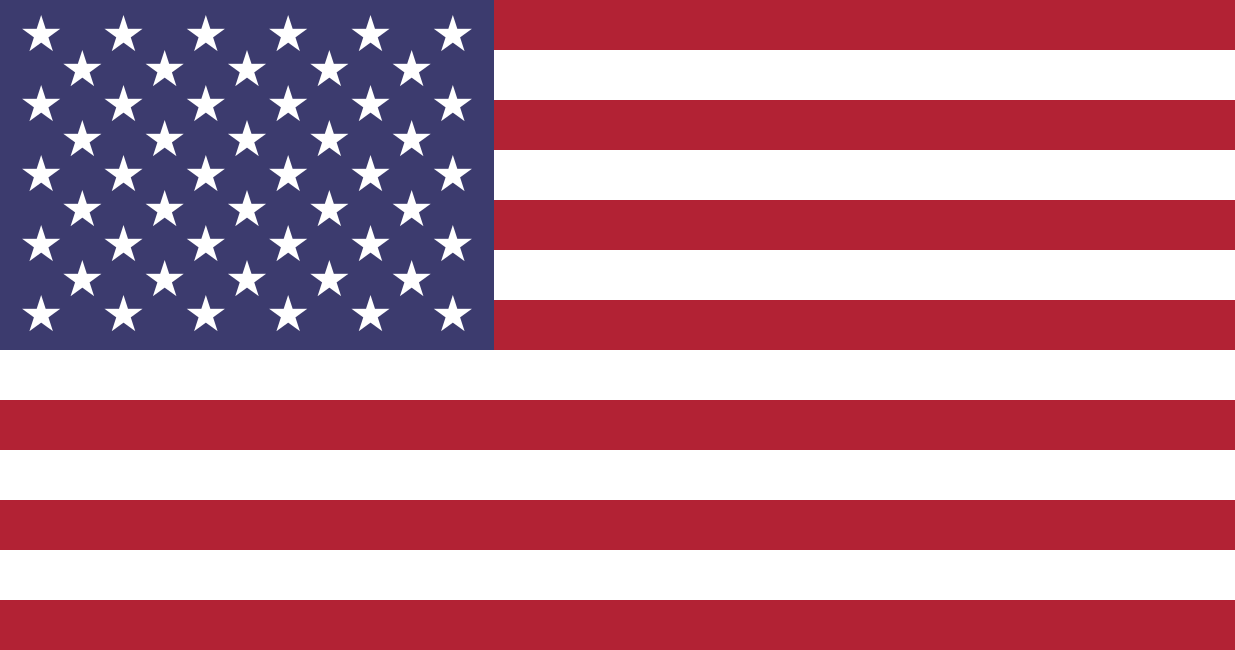
.US Domain at a Glance
- Registry Registry Services, LLC — on behalf of the U.S. Department of Commerce
- Root zone delegation 15 February 1985
- Eligibility Nexus — one of three categories, continuing
- If Nexus fails 30-day hold, then cancellation with no refund
- Dispute procedures usDRP, usRS and the eligibility-based Nexus Dispute Policy
- IDN support None — the registry does not offer IDN registrations
- Document Requirement No documents are required to register a .us domain
- Country United States
- Character Length 1 - 63 characters
- Registration Period 1 - 10 years
- Name Server Count 1 - 13 servers
.us Domain Prices — No Surprise Fees
Registration, transfer and renewal fees are listed separately. The renewal price can differ from the first-year price, so you see both up front.
-
New Registration
$11.99 /year -
Transfer
$12.00 /year -
Renewal
$14.99 /year -
Restore
$134.90 -
Late Renewal
$3.00 -
Trustee Service
$1.00
Included With Every .us Domain
-
Free DNS management
Change A, MX, TXT and CNAME records yourself from the panel — no waiting on anyone when you move a site or mailbox.
-
Domain lock
While the lock is on, nobody can move your domain to another registrar without your approval.
-
Domain forwarding
Point the domain at your existing site, a campaign page or a social profile — at no extra cost.
-
Free WHOIS privacy
Your name, address and phone stay out of public WHOIS records, which cuts down spam and scam calls.
.us Domain Lifecycle
What happens day by day after it expires
Day 0 is the domain's expiry dateIn short: for .us the post-expiry timeline is set by the registry, so it differs from one extension to the next. The diagram below shows the windows that actually apply to .us, day by day. One thing never changes, whichever extension you hold: renewing before the expiry date is always the cheapest and safest route.
Domain Is Available (Available)
A .us address at this stage has not been taken yet, and it goes to whoever registers first. Check the name you have in mind — if it is free, it can be yours within minutes.
Domain Is Active (Active Period)
Once registration is complete, the domain is registered to you for the term you selected. You can renew at any point before it expires to keep it active, or switch on auto-renewal so you never have to watch the date.
Redemption Period (Redemption Period)
The domain is not released the moment it expires — during this window it is still yours and can be recovered. Some extensions charge an extra restore fee at this stage, so renewing before expiry is always the cheaper route.
Pending Delete Period (Pending Delete Period)
If the redemption window is missed too, the domain enters the final stage and waits to be deleted. Renewal and recovery are no longer possible here; when the period ends the registration is removed for good.
Domain Is Available Again
Once deletion completes, the domain leaves the system and anyone can register it — popular names are often taken the same minute by someone watching. Keep auto-renewal on so a name you care about never gets this far.
.us Domain Specifications and Registration Rules
Registration conditions, supported features and the registry's own timelines in a single table.
.us Domain Registration
- Document Requirement No documents are required to register a .us domain
- Country United States
- Character Length 1 - 63 characters
- Registration Period 1 - 10 years
- Name Server Count 1 - 13 servers
.us Domain Support
- IDN Support No
- Transfer Support Yes
- Late Renewal Support Yes
Trustee Requirement for .us Domains
Frequently Asked Questions About .us Domains
The questions people actually ask before registering — answered plainly.
-
Yes, but conditionally. The third Nexus category covers foreign entities with a bona fide presence in the United States; the applicant certifies this on the basis of «real and substantial lawful connections with, or lawful activities in» the country. You do not need a US-incorporated company, but you do need a concrete business link and the ability to evidence it if asked. The registry does not collect documents at application; it runs spot checks on selected records, and at that stage a foreign entity may produce a bill of sale with a US buyer, or a deed or lease showing its US address.
-
One of three categories proving the holder's link to the United States. Category 1: a natural person who is a US citizen, a permanent resident, or whose primary domicile is in the US. Category 2: an entity incorporated in one of the fifty states, the District of Columbia or a US possession or territory — including federal, state and local government and US-based non-commercial organisations. Category 3: a foreign entity with a bona fide presence in the country. The requirement is not a one-off: the policy states plainly that holders must remain in compliance throughout the registration.
-
The name goes on a thirty-day hold. During that period the registrar is notified and given the chance to correct the information with the registrant. If the registrar takes no action within the thirty days, the registration is cancelled, the name returns to available status and the registration fee is not refunded. If the registrar demonstrates compliance and corrects the data, the hold is released and the name is registered. And if any one of the three certifications is missing at application — Nexus compliance, the category, or the name server statement — the application is rejected outright.
-
No, and this is not a preference but a prohibition. The privacy policy in force expressly bars a registrar, its resellers, affiliates and contractors from offering anonymous or proxy registration services, and a registrar may not use its own contact details as registration data either. Two reasons are given: keeping a complete whois database and being able to enforce Nexus. The registry also describes the enforcement — it runs an algorithm to detect such registrations. You can check the visible data of your record on the whois search page.
-
The rules define no such route. The Nexus requirement attaches to the registrant personally: you meet it, you certify it, and you produce the evidence in a check. On top of that, proxy registration services are separately prohibited by the privacy policy. So «handing the eligibility test to an intermediary and standing behind it» is not merely unregulated here but directly contrary to policy. If you have no link to the US, the answer is not an intermediary but an alternative without an eligibility test, such as .us.com.
-
Up to ten years. The limit is written into the registry's transfer policy: a transfer extends the registration by one year, «provided that in no event shall the total unexpired term of a registration exceed ten (10) years». Pricing is built as an annual subscription, with multi-year subscriptions also offered. One practical detail on transfers: when a holder-authorised change of registrar completes, the registration is automatically extended by a year. You can start the move on the domain transfer page.
-
No. The registry says so directly in its own FAQ: .us does not currently offer IDN registrations, and it suggests checking the official site for updates. A .us address containing characters such as ş, ğ, ü, ö, ç or ı therefore cannot be registered; names are built from ASCII letters, digits and the hyphen only. That is a real constraint for brands whose names carry such characters — plan the ASCII rendering of your brand before you buy.
-
There are three routes and ICANN's UDRP is not among them — the registry states plainly that, as a country-code TLD, .us is not bound by ICANN policies. The first is usDRP, the classic trademark-based procedure; the second is usRS, rapid suspension; the third is the zone-specific Nexus Dispute Policy. The last one is different in kind: the complainant argues not that a trademark is infringed but that the holder does not meet the eligibility requirement. The registry publishes its list of approved dispute providers separately.
-
If a panelist decides against the holder, the registry does not implement the decision at once: it waits ten business days. If within that period the holder produces official documentation — for example a complaint file-stamped by the clerk of the court — showing that a lawsuit has been commenced against the complainant in a US court to whose jurisdiction the complainant has submitted, the decision is not carried out. The administrative procedure therefore does not close the courtroom door; either party may take the dispute to a competent US court before or after the mandatory proceeding.
Ready to Claim Your .us Domain?
Type a name and see in seconds whether it is free on .us. If it is taken, we list close alternatives right away.
Get Help for .us Domain Registration
Need help registering a .us domain? Our team is ready to assist.