.ru Domain: Russia's Official Country Extension
.ru is the country code top-level domain (ccTLD) of Russia, entered into the root zone on 7 April 1994. The zone is governed by the Coordination Center for TLD RU, and names are registered through the registrars on the official list. Since 1 September 2026 the rules are written by the state rather than the Center: «Правила регистрации доменных имен», approved by Russian Government Decree No. 1119 of 31 August 2026, was published and took effect that same day and runs until 1 September 2032.
The zone is no longer open to all comers. Registration and renewal now depend on the holder record passing ESIA identification, which in practice means the administrator must be a Russian citizen or a company established in Russia. The Coordination Center separates four cases: foreign individuals holding Russian temporary residence, a residence permit or a work patent, and foreign companies with an accredited branch in Russia, can pass the check; foreign individuals with no Russian status and foreign companies with no Russian presence cannot. The country's older extension .su falls under the same condition, while .com.ru is a separate arrangement inside .RU.
The legal basis is article 14.2 of federal law No. 149-FZ as amended by No. 569-FZ of 29 December 2025. The scope reaches well past new registrations: renewal, nameserver changes, administrator or holder changes, a change of registrar and delegation all call for the same check. The calendar, however, is softer than it looks. The Coordination Center has announced that registrars accredited before 1 September 2026 keep accepting applications without interruption until they are entered on the government list, and that window closes on 18 January 2027 at the latest. So today many registrars still work the old way, without asking for ESIA.
For those who cannot pass the check, the Coordination Center's own advice fits in one sentence: hand the right to administer the name to a person or organisation with a Russian presence and a confirmed ESIA account. That is precisely what a trustee service does — Atak Domain's ESIA-verified representative account in Russia is recorded as the administrator, while the domain stays under your control and renewals and technical operations run through that account. If your name sits with another registrar, move it across with domain transfer first and then activate the trustee service; to check a new name, use domain search.
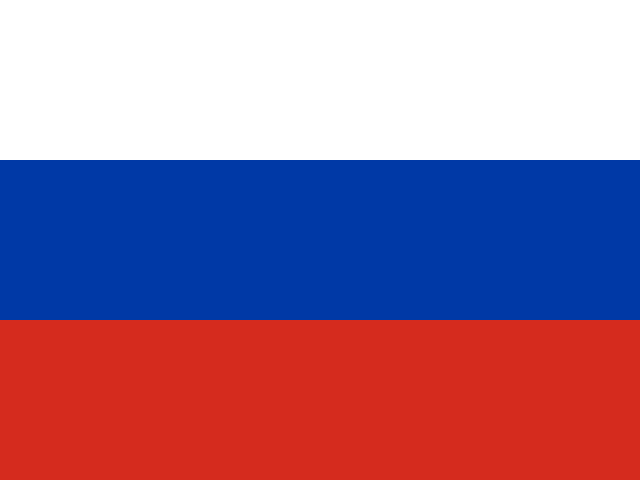
.RU Domain at a Glance
- Registry Coordination Center for TLD RU (Координационный центр национального домена сети Интернет)
- Delegated 7 April 1994
- Rules in force RF Government Decree No. 1119 of 31.08.2026, applied since 1 September 2026
- Identity verification Mandatory through Gosuslugi (ЕСИА); transition completes by 18 January 2027 at the latest
- Preferential renewal period 30 days after the registration term ends
- Owners outside Russia Without Russian status, managed through a trustee service
- Document Requirement No documents are required to register a .ru domain
- Country Russia
- Character Length 2 - 63 characters
- Registration Period 1 years
- Name Server Count 2 - 13 servers
.ru Domain Prices — No Surprise Fees
Registration, transfer and renewal fees are listed separately. The renewal price can differ from the first-year price, so you see both up front.
-
New Registration
$39.99 /year -
Transfer
$39.99 /year -
Renewal
$49.99 /year -
Restore
$79.90 -
Late Renewal
$7.00 -
Trustee Service
$99.99
Included With Every .ru Domain
-
Free DNS management
Change A, MX, TXT and CNAME records yourself from the panel — no waiting on anyone when you move a site or mailbox.
-
Domain forwarding
Point the domain at your existing site, a campaign page or a social profile — at no extra cost.
.ru Domain Lifecycle
What happens day by day after it expires
Day 0 is the domain's expiry dateIn short: for .ru the post-expiry timeline is set by the registry, so it differs from one extension to the next. The diagram below shows the windows that actually apply to .ru, day by day. One thing never changes, whichever extension you hold: renewing before the expiry date is always the cheapest and safest route.
Domain Is Available (Available)
A .ru address at this stage has not been taken yet, and it goes to whoever registers first. Check the name you have in mind — if it is free, it can be yours within minutes.
Domain Is Active (Active Period)
Once registration is complete, the domain is registered to you for the term you selected. You can renew at any point before it expires to keep it active, or switch on auto-renewal so you never have to watch the date.
Domain Is Available Again
Once deletion completes, the domain leaves the system and anyone can register it — popular names are often taken the same minute by someone watching. Keep auto-renewal on so a name you care about never gets this far.
.ru Domain Specifications and Registration Rules
Registration conditions, supported features and the registry's own timelines in a single table.
.ru Domain Registration
- Document Requirement No documents are required to register a .ru domain
- Country Russia
- Character Length 2 - 63 characters
- Registration Period 1 years
- Name Server Count 2 - 13 servers
.ru Domain Support
- IDN Support No
- Transfer Support Yes
- Late Renewal Support Yes
Trustee Requirement for .ru Domains
Frequently Asked Questions About .ru Domains
The questions people actually ask before registering — answered plainly.
-
Under the new rules, only in specific cases. Registration and renewal depend on the administrator passing identity verification through Gosuslugi (ЕСИА). The Coordination Center separates four cases:
- Foreign individuals holding Russian temporary residence, a residence permit or a work patent: can register with a confirmed ESIA account.
- Foreign companies with an accredited branch in Russia: can register with tax-service accreditation, the director's qualified electronic signature and an organisation account in ESIA.
- Foreign individuals with no status in Russia: cannot — ESIA identification is not open to them.
- Foreign companies with no Russian presence: cannot — no organisation account in ESIA.
In short, the holder record has to belong to a Russian citizen or a company established in Russia. If you fall outside that table, a trustee service puts a verified local administrator in place for you.
-
Federal law No. 569-FZ took effect that day and moved rule-making to the state. The same day brought the new «Правила регистрации доменных имен», approved by Russian Government Decree No. 1119 of 31 August 2026; it replaced the text the Coordination Center had written for fifteen years and runs until 1 September 2032. A second decree, No. 1120, replaced accreditation with a government-maintained list of registrars. What changes in practice: registration, renewal, DNS changes, administrator changes, a change of registrar and delegation now require identity confirmation through a confirmed Gosuslugi account, and the holder renews that check every year. The rollout, though, is staged: registrars accredited before 1 September keep working the old way until they move onto the government list, and that window closes on 18 January 2027 at the latest.
-
The registration is not wiped at once, but the doors close one by one. In the Coordination Center's own words nobody takes the domain away from you: if you need no changes, you can keep using an existing registration until its term runs out. Once your registrar moves to the new regime, however, a renewal request is not processed without the check, and holder changes and registrar changes sit behind the same gate. If the term ends without a renewal, delegation stops and the site and mail become unreachable; a 30-day preferential renewal period then runs, and if that passes too the registration is cancelled and the name opens to everyone. For an address with brand value there is usually no way back — settle the verification, or the trustee service, well before your renewal date.
-
It puts a local party in place to pass the check for you. Atak Domain's ESIA-verified representative account in Russia is recorded as the domain's administrator, and renewals, nameserver changes and transfers are carried out through it. The domain stays in your panel and you decide how it is used; only the registry record the regulation looks at changes. It runs as an administrator / holder change application, and that paperwork belongs to the application, not to the registration: companies submit a Russian-language notarised application form on letterhead, a trade registry extract and proof of signing authority; individuals submit a passport or ID copy and the same notarised form (no apostille required). Scope and current pricing: trustee service; the document checklist, the price breakdown and every application step are set out in the .ru domain trustee guide.
-
No. The rule does not care when the name was registered. There is one nuance: no blanket sweep happened that day, the check is demanded at the moment of an operation. So if you need no changes at all, the address keeps working until its term ends; but once your registrar moves to the new regime, renewal, DNS changes, administrator changes and transfers will not go through without it. No "early registration" exemption is provided; an address you have held for years and a name bought today go through the same gate. Plan your existing portfolio at least as early as new names: completing a trustee application before the renewal date approaches is both faster and cheaper than repairing the situation afterwards.
-
Moving the record to another registrar runs on an AuthInfo (EPP) code. Four situations block a transfer: the registration term has expired; fewer than 30 days have passed since the holder changed; fewer than 30 days have passed since the previous change of registrar; or a registrar request to confirm registry data has gone unanswered. The steps: get the AuthInfo code from your current registrar, lift the lock if one is set, start the process on the domain transfer page and approve the confirmation sent to the address in the WHOIS record — it usually takes 5–7 business days. One detail worth keeping in mind: a .ru transfer does not add a year to the expiry date; only the registrar changes, and renewal stays a separate action. Once the transfer is done you can activate the trustee service.
-
Not for anything you run through Atak Domain. Registration, renewal and transfer are paid for with standard international payment methods, and card or wire restrictions on the Russian side never enter that flow. This is the scenario we see most often in practice: the domain is technically renewable, but the holder cannot pay the Russian registrar and the term runs out. If you are stuck on payment or account access, moving the domain to Atak Domain is the first step to take — well before the registration is lost.
-
The data is no longer keyed in at each registrar separately; it comes straight from the Gosuslugi account — the convenience the Coordination Center highlights. For individuals the verified fields are full name and patronymic, date of birth, passport details (series, number, date of issue, issuing authority and unit code), registered address, email and phone. For legal entities it is the organisation name, ИНН and ОГРН, legal address, legal-form code (ОКОПФ) and the organisation's email and phone. What ESIA changes is this: identity is proved by a confirmed account rather than a paper trail — a confirmed Gosuslugi account for an individual, and an organisation account linked to it for a company. If the contract and ESIA data disagree, the operation stops — compare the two in advance.
-
Under the rules, delegation stops when the registration term ends: the address goes off the air that day and the registrar points the name to temporary DNS servers that redirect to its own notice page. A 30-day preferential renewal period then begins, during which only the previous holder may renew, and the registrar must send reminders 5–10 and 20–25 days after expiry. If the period runs out without renewal, the registration is cancelled and the name becomes available to everyone.
-
Partly. The rules set out what the WHOIS service publishes: the domain name, its DNS servers, delegation status, registration date, expiry date, the end of the preferential renewal period and the registrar supporting the record. On the holder side there is a split: a legal person's name is published in Latin script together with its tax number, while an individual is shown anonymously, with only an indication that the name belongs to a natural person. Run a lookup on the whois search page.
-
The technical conditions are spelled out: the name must be at least two and at most 63 characters, must begin and end with a letter or a digit, and may contain only letters, digits and hyphens. Latin letters apply and case is not distinguished. One detail catches people out: hyphens cannot occupy the third and fourth positions at the same time. The Coordination Center also maintains a stop-list of strings that cannot be registered, and whether a string is on it can be checked through WHOIS.
-
All four point at the same country but are different arrangements. .ru is the national zone run by the Coordination Center. .рф is the Cyrillic national zone run by the same Center, and the 1 September 2026 condition applies to it too; taking it alongside .ru is a common choice for brand protection. .su is a separate top-level domain entered into the root zone in 1990, administered by АНО «РосНИИРОС», and the same ESIA condition applies there as well. .com.ru is not a top-level domain at all: it is a second-level name registered inside .RU since 1997, and the names you buy open at the third level beneath it.
Ready to Claim Your .ru Domain?
Type a name and see in seconds whether it is free on .ru. If it is taken, we list close alternatives right away.
Get Help for .ru Domain Registration
Need help registering a .ru domain? Our team is ready to assist.