.ph Domain: the Philippines' Country Code and Short Address
.ph is the country code extension of the Philippines and was entered into the root zone on 14 September 1990, so the namespace has been running for more than thirty-five years. IANA records the delegation in the name of the PH Domain Foundation in Pasig, while the zone is run commercially by dotPH, which publishes the full rulebook itself. The same registry also runs .com.ph and .org.ph, and all three namespaces sit under a single service agreement. Direct second-level registration is nothing new here: a measurement on 15 August 2026 found abc.ph continuously registered since 20 October 1999.
Registration is open to anyone. You do not need to live in the Philippines, hold a company there or submit documents; the only eligibility test the registry applies is that the applicant be an identifiable individual over eighteen or a legally recognised entity. The naming rules, by contrast, are strict: one- and two-character names are disallowed, all-numeric names are rejected, and a hyphen may only appear in the middle. What separates the sibling zones is position rather than law — corporate addresses cluster on .com.ph, institutional and civil-society names on .org.ph.
Changing owner or provider follows the familiar authorisation-code route: you obtain an Auth Code from the current registrar and the move completes with it. Two situations stop a transfer before it starts — a status of Client Transfer Prohibited on the name, or an expiry date already in the past. Checking for both before you begin costs far less than paying and waiting. If you already hold a .ph name, you can start the move from the domain transfer page.
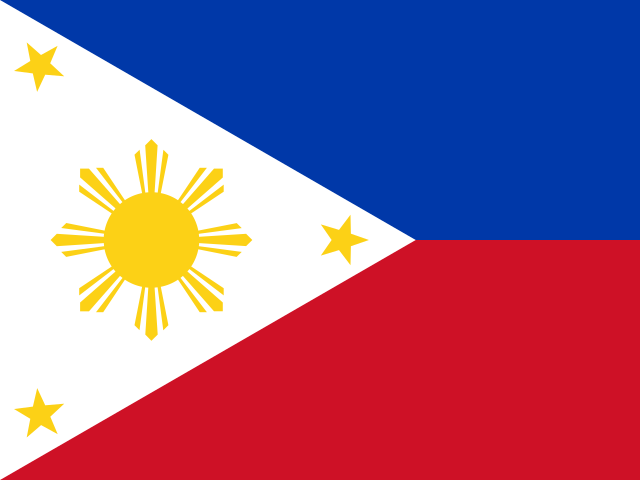
.PH Domain at a Glance
- Registry PH Domain Foundation (Pasig) — operated by dotPH
- Root zone entry 14 September 1990
- Oldest measured registration abc.ph — 20 October 1999
- Dispute procedure dotPH UDRP; providers WIPO and HKIAC
- Lookup channel whois.dot.ph web form; no port 43 WHOIS, no RDAP
- Governing law Hong Kong law and Hong Kong courts
- Document Requirement No documents are required to register a .ph domain
- Country Phillipines
- Character Length 3 - 63 characters
- Registration Period 1 - 10 years
- Name Server Count 2 - 13 servers
.ph Domain Prices — No Surprise Fees
Registration, transfer and renewal fees are listed separately. The renewal price can differ from the first-year price, so you see both up front.
-
New Registration
$84.39 /year -
Transfer
$84.99 /year -
Renewal
$108.99 /year -
Restore
$113.75 -
Late Renewal
$21.78
Included With Every .ph Domain
-
Free DNS management
Change A, MX, TXT and CNAME records yourself from the panel — no waiting on anyone when you move a site or mailbox.
-
Domain lock
While the lock is on, nobody can move your domain to another registrar without your approval.
-
Domain forwarding
Point the domain at your existing site, a campaign page or a social profile — at no extra cost.
.ph Domain Lifecycle
What happens day by day after it expires
Day 0 is the domain's expiry dateIn short: for .ph the post-expiry timeline is set by the registry, so it differs from one extension to the next. The diagram below shows the windows that actually apply to .ph, day by day. One thing never changes, whichever extension you hold: renewing before the expiry date is always the cheapest and safest route.
Domain Is Available (Available)
A .ph address at this stage has not been taken yet, and it goes to whoever registers first. Check the name you have in mind — if it is free, it can be yours within minutes.
Domain Is Active (Active Period)
Once registration is complete, the domain is registered to you for the term you selected. You can renew at any point before it expires to keep it active, or switch on auto-renewal so you never have to watch the date.
Domain Is Available Again
Once deletion completes, the domain leaves the system and anyone can register it — popular names are often taken the same minute by someone watching. Keep auto-renewal on so a name you care about never gets this far.
.ph Domain Specifications and Registration Rules
Registration conditions, supported features and the registry's own timelines in a single table.
.ph Domain Registration
- Document Requirement No documents are required to register a .ph domain
- Country Phillipines
- Character Length 3 - 63 characters
- Registration Period 1 - 10 years
- Name Server Count 2 - 13 servers
.ph Domain Support
- IDN Support No
- Transfer Support Yes
- Late Renewal Support Yes
Frequently Asked Questions About .ph Domains
The questions people actually ask before registering — answered plainly.
-
No. dotPH's applicant policy defines the holder in two classes: an identifiable individual over eighteen, or a legally recognised statutory entity. There is no nationality test, no residency requirement, no local contact and no document to submit. The registry asks only for a legal first and last name, a valid postal address, a working e-mail address and a telephone number including the country code. A measurement on 15 August 2026 bears this out: google.ph is held by Google LLC of Mountain View. What the registry does enforce is accuracy — false or stale data is grounds for suspension or cancellation without notice and without refund.
-
Three characters. The rulebook disallows one- and two-character names outright and caps the label at 63 characters. Measurement confirms it: on 15 August 2026 the registry's own lookup returned "Please provide a valid domain name" for both a.ph and zq.ph, meaning a two-letter label is not merely unavailable but syntactically invalid. The two-letter names that do exist in the zone prove the rule rather than break it — ab.ph, ai.ph and ph.ph were all taken into dotPH's own name in May 2024. Three characters, by contrast, genuinely trade: abc.ph has been held by a company since 1999.
-
The registry offers a discrete ladder rather than a continuous range: three months, one year, two years, five years or ten years. Terms of three, four, six, seven, eight or nine years simply have no product behind them. The ten-year ceiling was verified by measurement: on 15 August 2026 redcross.org.ph carried an expiry date of 13 July 2036 and wwf.org.ph one of 23 July 2036. The three-month product has its own rule — once renewed to at least a year, it cannot drop back to a shorter term. Auto-renewal charges seven days before the expiry date.
-
There is no grace period of fixed length. The term policy says your right of first refusal to renew ends on the last day of the period already paid for, and the registry's support text states that an expired name can be renewed only for as long as it has not been deleted, that deletion may happen at any time, and that continued availability for renewal cannot be guaranteed. No penalty redemption stage exists either. Once deleted, the name is open to anyone. The practical upshot on .ph is blunt: missing the expiry date leaves recovery to chance, so renewing early is the real safeguard.
-
The transfer runs on an authorisation code. You request it from the current registrar, where it may be called an Auth Code, EPP Key or Transfer Code, and the gaining side starts the move with it. Two conditions stop the process before it begins: a status of Client Transfer Prohibited or Client Update Prohibited on the name, or an expiry date already passed. Measurement shows these locks in real use — google.ph carries all three prohibitions. Premium names cannot be moved to another PH registrar at all. You can start the move from the domain transfer page.
-
In rules, nothing. Both are namespaces of the same registry under the same service agreement, the same eligibility test, the same naming rules and the same dispute procedure. The difference shows up in use. .com.ph is the country's established corporate address: measured on 15 August 2026, sm.com.ph has been registered since 1999, pldt.com.ph since 2000 and jollibee.com.ph since 2001. .ph is where short, brand-led names live, and the registry's own marketing is built on the brand.ph pattern. Choose .com.ph for institutional recognition, .ph for brevity.
-
Yes. dotPH sells an annual privacy service called Private Registration that removes contact details from WHOIS results. Measurement shows it working in the field: on 15 August 2026 the records for jollibee.com.ph and globe.com.ph returned "Privacy Protected by Registry" in the name, organisation, address and country fields alike. Even without the service the registrant e-mail comes back partly masked by default. The zone has no WHOIS server on port 43 and no RDAP service, so lookups run only through the registry's web form. You can run your own query from the whois search page.
Ready to Claim Your .ph Domain?
Type a name and see in seconds whether it is free on .ph. If it is taken, we list close alternatives right away.
Get Help for .ph Domain Registration
Need help registering a .ph domain? Our team is ready to assist.