.pr Domain: The Country Extension of Puerto Rico
.pr is the country-code extension for Puerto Rico and entered the root zone on 27 August 1989, making it one of the internet's first-generation country domains. The registry is run by Gauss Research Laboratory, Inc. of San Juan. The zone began inside the University of Puerto Rico in the late 1980s and later moved to this company, which still sets the rules today. The technical back end belongs to a separate firm, Identity Digital, whose platform serves the name servers and the WHOIS service.
The extension is fully open to applicants abroad. Neither the registration agreement nor the registry's own question-and-answer page asks for residence, incorporation or a representative in Puerto Rico; names are allocated first come, first served, and no cap applies to how many a person or company may hold. You can verify this in the public record: a share of live .pr names is held through registrars in Australia and the United Kingdom on behalf of companies based on the US mainland. If you prefer a commercial name at the third level, com.pr falls under the same agreement.
For trademark conflicts Puerto Rico has adopted ICANN's UDRP, with complaints filed to WIPO or the National Arbitration Forum. Disputes arising from the agreement itself are governed by the law of Puerto Rico, with the courts of San Juan holding jurisdiction. In 2020 the registry released more than 64,000 names it had reserved for years, which is why short and generic strings can still be available. Check what your preferred name looks like today on the domain name search page.
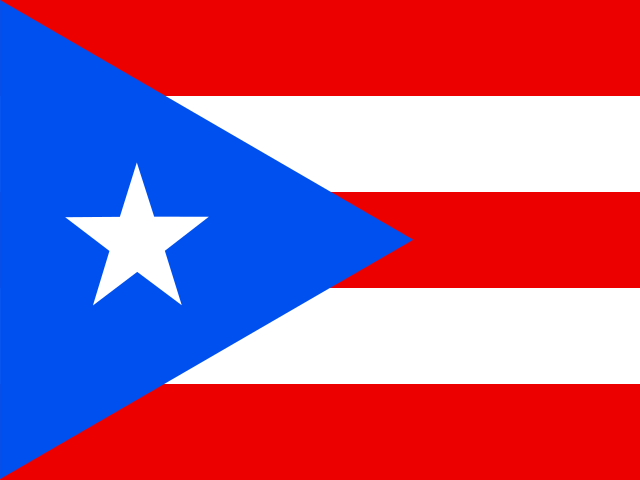
.PR Domain at a Glance
- Registry Gauss Research Laboratory, Inc. (San Juan, Puerto Rico)
- In the root zone since 27 August 1989
- Technical operator Identity Digital (formerly Afilias / Donuts)
- Dispute procedure UDRP; providers are WIPO and the National Arbitration Forum
- Governing law Law of Puerto Rico; courts of San Juan have jurisdiction
- 2020 release More than 64,000 names held back by the registry were opened
- Document Requirement Documents are required to register a .pr domain
- Country Puerto Rico
- Character Length 3 - 63 characters
- Registration Period 1 - 10 years
- Name Server Count 1 - 13 servers
.pr Domain Prices — No Surprise Fees
Registration, transfer and renewal fees are listed separately. The renewal price can differ from the first-year price, so you see both up front.
-
New Registration
$1,399.00 /year -
Transfer
$1,099.00 /year -
Renewal
$1,787.50 /year -
Restore
$1,500.00 -
Late Renewal
$294.80
Included With Every .pr Domain
-
Free DNS management
Change A, MX, TXT and CNAME records yourself from the panel — no waiting on anyone when you move a site or mailbox.
-
Domain lock
While the lock is on, nobody can move your domain to another registrar without your approval.
-
Domain forwarding
Point the domain at your existing site, a campaign page or a social profile — at no extra cost.
-
Free WHOIS privacy
Your name, address and phone stay out of public WHOIS records, which cuts down spam and scam calls.
.pr Domain Lifecycle
What happens day by day after it expires
Day 0 is the domain's expiry dateIn short: for .pr the post-expiry timeline is set by the registry, so it differs from one extension to the next. The diagram below shows the windows that actually apply to .pr, day by day. One thing never changes, whichever extension you hold: renewing before the expiry date is always the cheapest and safest route.
Domain Is Available (Available)
A .pr address at this stage has not been taken yet, and it goes to whoever registers first. Check the name you have in mind — if it is free, it can be yours within minutes.
Domain Is Active (Active Period)
Once registration is complete, the domain is registered to you for the term you selected. You can renew at any point before it expires to keep it active, or switch on auto-renewal so you never have to watch the date.
Redemption Period (Redemption Period)
The domain is not released the moment it expires — during this window it is still yours and can be recovered. Some extensions charge an extra restore fee at this stage, so renewing before expiry is always the cheaper route.
Pending Delete Period (Pending Delete Period)
If the redemption window is missed too, the domain enters the final stage and waits to be deleted. Renewal and recovery are no longer possible here; when the period ends the registration is removed for good.
Domain Is Available Again
Once deletion completes, the domain leaves the system and anyone can register it — popular names are often taken the same minute by someone watching. Keep auto-renewal on so a name you care about never gets this far.
.pr Domain Specifications and Registration Rules
Registration conditions, supported features and the registry's own timelines in a single table.
.pr Domain Registration
- Document Requirement Documents are required to register a .pr domain
- Country Puerto Rico
- Character Length 3 - 63 characters
- Registration Period 1 - 10 years
- Name Server Count 1 - 13 servers
.pr Domain Support
- IDN Support No
- Transfer Support Yes
- Late Renewal Support Yes
Frequently Asked Questions About .pr Domains
The questions people actually ask before registering — answered plainly.
-
Yes. No clause of the registration agreement asks for residence, incorporation, a local address or a representative in Puerto Rico; the registry's own question-and-answer page ties registration only to complying with the agreement and states that names are allocated first come, first served. Practice confirms it: a share of live .pr names is held through registrars in Australia and the United Kingdom on behalf of companies outside Puerto Rico. No additional local-link obligation is published for foreign applicants.
-
Not at registration. The application section of the agreement asks only for contact details, a warranty that the information is accurate, and a management account; no identity document, company record or trademark certificate is requested. Documents appear only at change of ownership: whoever transfers a name must give the registry evidence of a transfer agreement, or another document proving consent that carries the current holder's name and signature. The paperwork sits at the handover, not at the purchase.
-
The agreement requires three to 63 characters; letters, digits and the hyphen are allowed, a name may not begin or end with a hyphen, and two consecutive hyphens are rejected. One- and two-character names are closed to the public: the registry WHOIS answers a two-letter query with an explicit "this name is reserved by the Registry", and single letters are registered to the registry itself. Accented characters have been supported since 2008, though the list covers Spanish and French letters only.
-
The agreement defines transfer to cover two situations at once: a change of registrar and a change of registrant. In both cases the registry is notified in advance, the full registration data of the incoming holder is supplied, and a signed document evidencing consent is attached. The name string and its extension can never be modified, so there is no such thing as renaming a domain — a different string is a new registration. You can start the process from the domain transfer page.
-
Yes, and the disclosure here is wide. The registry WHOIS publishes the registrant's name, organisation, street address, telephone number and e-mail, and anyone can read it over port 43 or through the registry's web lookup. In large corporate records under com.pr, the company name and headquarters address are plainly legible. If you are planning a personal registration, factor that visibility in from the start; you can confirm the detail on the WHOIS search page.
-
Puerto Rico has adopted ICANN's UDRP and made it an integral part of the agreement: the registrant accepts that a name may be blocked, cancelled or transferred to a third party as a result of a UDRP proceeding. Complaints may be filed with WIPO or the National Arbitration Forum, and the court route remains open alongside it. Disputes arising from the agreement itself are governed by the law of Puerto Rico, with the courts of San Juan holding jurisdiction.
-
Some are. In 2020 the registry released more than 64,000 names it had reserved for years, and dictionary words have been taken by third parties ever since. A measurement made today returns a mixed picture: several common words were registered between 2021 and 2025, while others remain free. If you are aiming at a short string, test a list rather than one candidate at a time using bulk domain name search.
Ready to Claim Your .pr Domain?
Type a name and see in seconds whether it is free on .pr. If it is taken, we list close alternatives right away.
Get Help for .pr Domain Registration
Need help registering a .pr domain? Our team is ready to assist.