.ke Domain: Kenya's Official Country Code Extension
.ke is the country code top-level domain of Kenya and entered the root zone on 29 April 1993. The extension is run by the Kenya Network Information Centre (KeNIC), a not-for-profit body incorporated as a company limited by guarantee under the Kenyan Companies Act, operating under a licence granted in 2015 by the country's regulator, the Communications Authority of Kenya. The date that shapes the extension today, however, is not 1993 but May 2017: until then Kenya sold names only at the third level, and one-part addresses opened only in 2017.
A direct .ke suits anyone who wants a short address in the Kenyan market without a category attached: the functional split used at the third level does not apply here, so your name carries no label describing what kind of organisation you are. Registration goes through accredited registrars only; the registry accepts no applications directly. No office, address or agent in Kenya is required, because the local presence condition falls on the registrar rather than the registrant. The country's established address format, .co.ke, is the third-level space reserved for companies, and the two do not block one another.
One detail is worth knowing before you order: very short names are not in free circulation at the direct second level. Every single-character name was taken during release rounds held between December 2021 and February 2024, and a substantial share of short strings sits on the registry's reserved list, returning as not registrable rather than as available. The space is still young, though: regulator figures put the number of direct .ke names at 7,871 as of 31 March 2026. Check what your chosen name actually returns on the domain name search page.
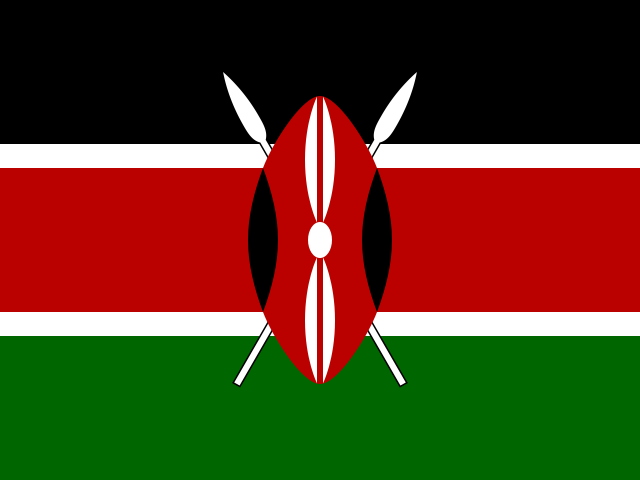
.KE Domain at a Glance
- Registry operator KeNIC — Kenya Network Information Centre, Nairobi
- Legal form of the registry Not-for-profit company limited by guarantee
- Regulator Communications Authority of Kenya (licensed 2015)
- Entered the root zone 29 April 1993
- Second level opened May 2017
- Direct .ke names registered 7,871 (regulator figures, 31 March 2026)
- Document Requirement No documents are required to register a .ke domain
- Country Kenya
- Character Length 3 - 63 characters
- Registration Period 1 - 5 years
- Name Server Count 2 - 10 servers
.ke Domain Prices — No Surprise Fees
Registration, transfer and renewal fees are listed separately. The renewal price can differ from the first-year price, so you see both up front.
-
New Registration
$119.99 /year -
Transfer
$124.79 /year -
Renewal
$134.39 /year -
Restore
$287.90
Included With Every .ke Domain
-
Free DNS management
Change A, MX, TXT and CNAME records yourself from the panel — no waiting on anyone when you move a site or mailbox.
-
Domain forwarding
Point the domain at your existing site, a campaign page or a social profile — at no extra cost.
.ke Domain Lifecycle
What happens day by day after it expires
Day 0 is the domain's expiry dateIn short: for .ke the post-expiry timeline is set by the registry, so it differs from one extension to the next. The diagram below shows the windows that actually apply to .ke, day by day. One thing never changes, whichever extension you hold: renewing before the expiry date is always the cheapest and safest route.
Domain Is Available (Available)
A .ke address at this stage has not been taken yet, and it goes to whoever registers first. Check the name you have in mind — if it is free, it can be yours within minutes.
Domain Is Active (Active Period)
Once registration is complete, the domain is registered to you for the term you selected. You can renew at any point before it expires to keep it active, or switch on auto-renewal so you never have to watch the date.
Redemption Period (Redemption Period)
The domain is not released the moment it expires — during this window it is still yours and can be recovered. Some extensions charge an extra restore fee at this stage, so renewing before expiry is always the cheaper route.
Domain Is Available Again
Once deletion completes, the domain leaves the system and anyone can register it — popular names are often taken the same minute by someone watching. Keep auto-renewal on so a name you care about never gets this far.
.ke Domain Specifications and Registration Rules
Registration conditions, supported features and the registry's own timelines in a single table.
.ke Domain Registration
- Document Requirement No documents are required to register a .ke domain
- Country Kenya
- Character Length 3 - 63 characters
- Registration Period 1 - 5 years
- Name Server Count 2 - 10 servers
.ke Domain Support
- IDN Support No
- Transfer Support Yes
- Late Renewal Support No
Frequently Asked Questions About .ke Domains
The questions people actually ask before registering — answered plainly.
-
No. There is no requirement for the registrant to hold an office, a local address or an agent in Kenya. The confusion has a clear source: the registry does mention local presence, but the subject of that sentence is the registrar — a company must have an office in Kenya to be accredited as a seller. No such condition applies to the end user. A company based in Türkiye, a sole trader or a private individual can therefore register a .ke name through an accredited registrar. Registration always runs through those registrars; the registry accepts no applications directly from end users.
-
Both sit with the same registry, the Kenya Network Information Centre. The difference is level and positioning. A .ke name is a one-part address that carries no specialisation, so nothing in it labels what kind of organisation you are. .co.ke is the third-level space defined for companies, e-commerce sites and retail businesses, and it is the established address format in Kenya. The numbers make the gap plain: regulator figures for 31 March 2026 record 110,687 names under co.ke against 7,871 registered directly at .ke. The two do not block each other, so you can hold the same name at both.
-
In May 2017. Kenya's extension entered the root zone on 29 April 1993, but from its founding until 2017 the registry sold names only at the third level: every applicant had to take a two-part address such as name.co.ke or name.or.ke. The one-part space opened in May 2017, and names in the form name.ke have been available since. That late opening has a practical consequence: because established Kenyan brands built their addresses at the third level, good names can still be free at the direct second level.
-
No. A direct .ke registration requires no paperwork and involves no pending approval step. The registry applies a document requirement to only three third-level spaces: go.ke for government bodies, ac.ke for institutions of higher education and sc.ke for lower and middle level schools. In those spaces a registration opens a support ticket, and the name is not published until the documents reach the registry and the ticket is closed. Neither the direct second level nor the commercial co.ke space involves that step; the name is published in the ordinary flow once your registrar submits it.
-
No. The registry publishes no public field about the registrant at all. A lookup returns the domain name, the registry identifier, the creation, update and expiry dates, the status codes, the name servers and the registrar's details. Fields for the registrant, administrative or technical contact are simply not printed — there is not even a redacted placeholder. The registry's RDAP service behaves identically: only the registrar appears as an entity in the response. You can check your own record on the whois search page.
-
The registry's rules expressly allow a change of registrar: holders may move their .ke names to the registrar of their choice. Because no single central authorisation-code procedure is published, you obtain the exact steps from your incoming registrar. One point deserves attention: names often carry a transfer lock applied by the current registrar. That is not a registry-wide ban, and you can ask your existing provider to lift it. A change of holder is a separate and slower process, which is why registering the name in the final owner's name from the outset is more practical. Start on the domain transfer page.
-
The UDRP procedure familiar from generic extensions does not operate here; the registry applies its own alternative dispute resolution policy, and the process has two stages. A complaint is filed with KeNIC on a lodging form; the registry verifies the holder through whois and first invites the parties to mediation. If no settlement is reached, the file moves to arbitration before an arbitrator certified by the registry, and if that produces no outcome the courts remain open. The available remedies are limited: transfer of the name, deletion of the name, or dismissal with the holder keeping it. Kenyan law applies.
Ready to Claim Your .ke Domain?
Type a name and see in seconds whether it is free on .ke. If it is taken, we list close alternatives right away.
Get Help for .ke Domain Registration
Need help registering a .ke domain? Our team is ready to assist.