.li Domain: Liechtenstein's Official Country Extension
.li is the country code top-level domain of the Principality of Liechtenstein and entered the root zone on 26 February 1993. Sovereignty over the extension belongs to the principality; the regulator is the national Office for Communications, which has commissioned the independent Switch foundation in Zurich to operate the registry under an administrative-law contract. The rules are Liechtenstein law as well: the text in force is the .li domain name ordinance, which has applied since 1 February 2025. Switch does not deal with end customers, so registration goes through accredited registrars only.
There are no eligibility conditions. The registry answers the question plainly on its own pages: you do not have to be a Liechtenstein citizen or resident to register a .li name, and no documents or trustee are required. Priority goes to whoever applies first, and a provisional reservation is not possible. The restrictions concern the name itself rather than the person: the annex to the ordinance reserves the country's municipality and locality names, princely and state terms, broadcasting names such as tv.li and rundfunk.li, and national cyber-security names such as cert.li and ncsc.li. Names with umlauts have been available since 1 March 2004.
The decisive detail on the registration side is the term: the registry keeps no expiry date, and a name stays yours until it is deleted or transferred; the annual period you see at your registrar is a billing period at provider level. If a name is deleted, a transition period begins in which no third party can take it and only the previous holder can restore it through a registrar; the practice the registry publishes is forty days. Your holder details are not published in the public lookup, which shows only your registrar's particulars. Check whether the name you want is free on the domain name search page.
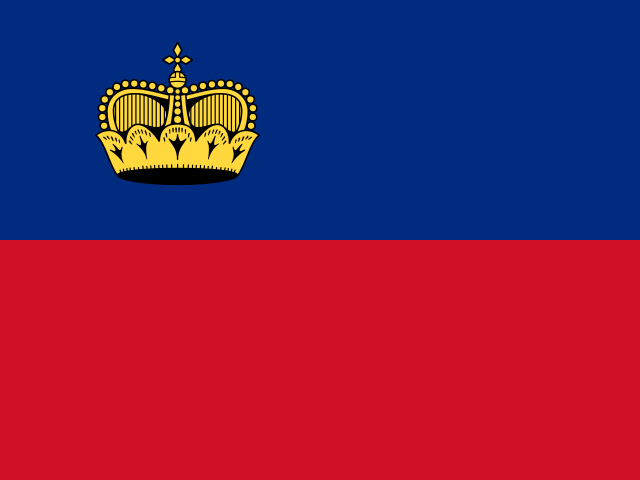
.LI Domain at a Glance
- Regulatory authority Amt für Kommunikation — Liechtenstein Office for Communications
- Registry operator Switch foundation, Zurich
- Entered the root zone 26 February 1993
- Names in the zone 71,932 (registry figure, 15 July 2026)
- Ordinance in force .li domain name ordinance, applicable since 1 February 2025
- Where the holders are About 18% of names are held by registrants based in Liechtenstein
- Document Requirement No documents are required to register a .li domain
- Country Liechtenstein
- Character Length 3 - 63 characters
- Registration Period 1 years
- Name Server Count 1 - 13 servers
.li Domain Prices — No Surprise Fees
Registration, transfer and renewal fees are listed separately. The renewal price can differ from the first-year price, so you see both up front.
-
New Registration
$21.42 /year -
Renewal
$31.99 /year -
Restore
$64.68 -
Late Renewal
$6.38
Included With Every .li Domain
-
Free DNS management
Change A, MX, TXT and CNAME records yourself from the panel — no waiting on anyone when you move a site or mailbox.
-
Domain forwarding
Point the domain at your existing site, a campaign page or a social profile — at no extra cost.
.li Domain Lifecycle
What happens day by day after it expires
Day 0 is the domain's expiry dateIn short: for .li the post-expiry timeline is set by the registry, so it differs from one extension to the next. The diagram below shows the windows that actually apply to .li, day by day. One thing never changes, whichever extension you hold: renewing before the expiry date is always the cheapest and safest route.
Domain Is Available (Available)
A .li address at this stage has not been taken yet, and it goes to whoever registers first. Check the name you have in mind — if it is free, it can be yours within minutes.
Domain Is Active (Active Period)
Once registration is complete, the domain is registered to you for the term you selected. You can renew at any point before it expires to keep it active, or switch on auto-renewal so you never have to watch the date.
Redemption Period (Redemption Period)
The domain is not released the moment it expires — during this window it is still yours and can be recovered. Some extensions charge an extra restore fee at this stage, so renewing before expiry is always the cheaper route.
Domain Is Available Again
Once deletion completes, the domain leaves the system and anyone can register it — popular names are often taken the same minute by someone watching. Keep auto-renewal on so a name you care about never gets this far.
.li Domain Specifications and Registration Rules
Registration conditions, supported features and the registry's own timelines in a single table.
.li Domain Registration
- Document Requirement No documents are required to register a .li domain
- Country Liechtenstein
- Character Length 3 - 63 characters
- Registration Period 1 years
- Name Server Count 1 - 13 servers
.li Domain Support
- IDN Support No
- Transfer Support Yes
- Late Renewal Support Yes
Frequently Asked Questions About .li Domains
The questions people actually ask before registering — answered plainly.
-
No. The registry poses this question on its own pages and answers it directly: you do not have to be a Liechtenstein citizen or resident to register a .li name. The ordinance likewise contains no provision on the registrant's nationality, residence or place of establishment; its grounds for refusal concern the name itself rather than the person. A company in Türkiye, a sole trader and a private individual are subject to identical terms, and no documents, local address or trustee are required. The registry also states the flip side plainly: you cannot assume a Liechtenstein person or company sits behind every .li name.
-
There is no term at registry level. The registry's terms define registration as open-ended and let a name end only through deletion or transfer; the ordinance contains no term clause either, describing the right acquired on allocation as a transferable and exclusive right of use. The annual period you see at your registrar is a billing period at provider level. The practical consequence is that the generic-extension chain of «expired, you are in the grace period» does not operate here and a name never lapses by itself. It is deleted when your registrar files a deletion request, so what matters is your payment relationship with your provider.
-
Three characters. The annex to the ordinance requires the name, or its punycode equivalent, to consist of «3 to 63 characters», and the registry's terms treat anything shorter than three or longer than sixty-three as a direct ground for refusal. The single exception is not one you can buy: in justified cases the regulator may allow a shorter name where an overriding public interest warrants it and the name will be used by the state or its institutions. The upper limit of sixty-three applies to the punycode form, so a name with umlauts shows fewer visible characters.
-
Yes, since 1 March 2004. The annex to the ordinance lists the permitted characters one by one: a–z, 0–9, the hyphen and thirty-two accented Latin letters such as ä, ö, ü, é, à and ç. The name enters the DNS in punycode form: bücher.li appears in the zone file as xn--bcher-kva.li. A commercially important caveat applies: the form with umlauts and the plain form are separate names and are not issued together automatically, so if you want both you must register both. The registry also gives no guarantee that such names work smoothly in every browser and mail client.
-
Yes, within the transition period. A deleted name is not released for re-allocation immediately: the registry's terms and support pages announce this period as forty days, during which no third party may register the name while your registrar can re-register it for you on request. The ordinance, for its part, sets a minimum of thirty days before the name becomes free. The safe reading is that you have at least thirty days, and forty according to the practice the registry publishes. If your registrar goes bankrupt or its contract ends, you have ninety days to move management elsewhere.
-
Fewer than a fifth. The registry's own statistics pages give the figures: only about eighteen percent of names belong to holders based in Liechtenstein, more than a third are held in Switzerland, and over sixty percent are registered to a company or organisation rather than an individual. This does not weaken the extension's identity claim, but it sets your expectations correctly: .li is not a locals-only zone, and registering from abroad is the rule here. With a little over seventy thousand names in the zone, short words long gone in the large extensions can still be free.
-
No. The ordinance lists the fields the registry must keep in a closed set: the name itself and its punycode form, the name servers, whether the name is protected with DNSSEC, the date of first allocation, and the particulars of the registrar managing it. Publishing holder data is not mandatory; the registry may publish it only where the holder is a legal entity or has consented. Those who credibly establish a legitimate interest are granted online access, and the registry may charge a reasonable fee for it. You can check what appears for your name on the whois search page.
-
Not through the procedure familiar from generic extensions, but through the registry's own two-stage service. The ordinance obliges the registry to set one up and frames it: proceedings are conducted by neutral and independent experts, the decision cannot award damages and concerns only the lawfulness of the allocation. The first stage is a conciliation call lasting no more than one hour; if no settlement is reached, an expert decision may be requested at the second stage. Substantively, the basis is a clear violation of Swiss or Liechtenstein trademark and unfair-competition law. An expert decision binds the registry unless civil proceedings are filed in time.
-
Do not confuse the two operations. For a change of registrar you request the transfer code (Auth-Code) from your current provider and pass it to the new one; the ordinance requires the registry to provide a technical and administrative procedure that makes this move simple, the holder does not change, and because registration is open-ended no days are lost. A change of holder is a separate procedure: the name is transferred to a third party through the managing registrar at the holder's request, and the third party must meet the conditions of allocation. Start on the domain transfer page.
Ready to Claim Your .li Domain?
Type a name and see in seconds whether it is free on .li. If it is taken, we list close alternatives right away.
Get Help for .li Domain Registration
Need help registering a .li domain? Our team is ready to assist.