.cl Domain: Chile's Official Country Code Extension
.cl is the country code top-level domain of Chile and entered the root zone on 15 December 1987. The registry is run not by a company but by a university unit: NIC Chile, part of the Computer Science Department in the Faculty of Physical and Mathematical Sciences at the University of Chile. Its authority rests on a delegation from IANA, formally recognised by a framework agreement signed with ICANN on 24 June 2006. The rules in force are the «Reglamentación para el funcionamiento del Registro de Nombres del Dominio .CL», dated 14 July 2020 and last amended by a faculty resolution of 1 June 2020.
On eligibility, .cl keeps almost no door closed: the regulation settles the question in a single sentence, allowing any natural or legal person, Chilean or foreign, to hold a name. The requirement that foreigners appoint a representative resident in Chile was dropped on 1 December 2013, so you register directly, with no trustee and no local address to arrange. Declaring an identity document number is optional too. There is also a structural difference: levels such as com.cl, net.cl or org.cl have never existed in Chile. Names have always been registered straight at the second level, so yourbrand.cl is the only address to secure.
Two details bear directly on your order. The first is expiry: the long grace chain you know from generic extensions does not exist here, the name is switched off on the day it expires and waits in restoration for thirty days only. The second is the name pool: single-letter names are permitted and are still registered through the ordinary flow, yet all thirty-six of them are taken, so in practice you start at two characters. Names with Spanish letters have been available since 2005. Check whether the name you want is free on the domain name search page.
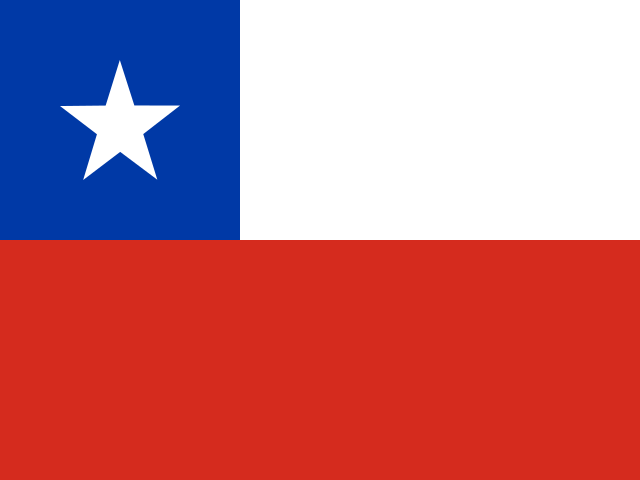
.CL Domain at a Glance
- Registry operator NIC Chile — University of Chile, Computer Science Department
- Entered the root zone 15 December 1987
- Names registered 765,722 (registry counter, 16 August 2026)
- Window after expiry 30 days of restoration, then permanent deletion
- Namespace structure No intermediate level — names sit directly at the second level
- Rules in force Reglamentación .CL, 14 July 2020
- Document Requirement No documents are required to register a .cl domain
- Country Chile
- Character Length 1 - 63 characters
- Registration Period 1 - 10 years
- Name Server Count 1 - 5 servers
.cl Domain Prices — No Surprise Fees
Registration, transfer and renewal fees are listed separately. The renewal price can differ from the first-year price, so you see both up front.
-
New Registration
$89.90 /year -
Transfer
$89.99 /year -
Renewal
$98.99 /year -
Restore
$83.98 -
Late Renewal
$19.80
Included With Every .cl Domain
-
Free DNS management
Change A, MX, TXT and CNAME records yourself from the panel — no waiting on anyone when you move a site or mailbox.
-
Domain lock
While the lock is on, nobody can move your domain to another registrar without your approval.
-
Domain forwarding
Point the domain at your existing site, a campaign page or a social profile — at no extra cost.
.cl Domain Lifecycle
What happens day by day after it expires
Day 0 is the domain's expiry dateIn short: for .cl the post-expiry timeline is set by the registry, so it differs from one extension to the next. The diagram below shows the windows that actually apply to .cl, day by day. One thing never changes, whichever extension you hold: renewing before the expiry date is always the cheapest and safest route.
Domain Is Available (Available)
A .cl address at this stage has not been taken yet, and it goes to whoever registers first. Check the name you have in mind — if it is free, it can be yours within minutes.
Domain Is Active (Active Period)
Once registration is complete, the domain is registered to you for the term you selected. You can renew at any point before it expires to keep it active, or switch on auto-renewal so you never have to watch the date.
Redemption Period (Redemption Period)
The domain is not released the moment it expires — during this window it is still yours and can be recovered. Some extensions charge an extra restore fee at this stage, so renewing before expiry is always the cheaper route.
Domain Is Available Again
Once deletion completes, the domain leaves the system and anyone can register it — popular names are often taken the same minute by someone watching. Keep auto-renewal on so a name you care about never gets this far.
.cl Domain Specifications and Registration Rules
Registration conditions, supported features and the registry's own timelines in a single table.
.cl Domain Registration
- Document Requirement No documents are required to register a .cl domain
- Country Chile
- Character Length 1 - 63 characters
- Registration Period 1 - 10 years
- Name Server Count 1 - 5 servers
.cl Domain Support
- IDN Support No
- Transfer Support Yes
- Late Renewal Support Yes
Frequently Asked Questions About .cl Domains
The questions people actually ask before registering — answered plainly.
-
No. The eligibility clause of the regulation settles it in one sentence: any natural or legal person, Chilean or foreign, may hold a .cl name. No company, office, representative or local address is required. The rule obliging foreigners to appoint a representative resident in Chile was dropped on 1 December 2013; until then an applicant abroad could only obtain a name by making someone living in Chile the administrative contact. Today a company based in Türkiye, a sole trader and a private individual all register on identical terms. Declaring a Chilean identity or tax number is optional as well, though the registry keeps the right to ask for documents where identity has to be verified.
-
Between one and ten years, in whole-year steps. The registry publishes its registration and renewal schedule with a separate line for every year from one to ten; there are no intermediate values and no two-year blocks. You may renew at any time before expiry, and the period you buy is added to the existing expiry date rather than to the day you apply, so renewing early costs you nothing. The one hard ceiling is on the total: the registry's management procedure states that under no circumstance may a domain's validity exceed ten years. That ceiling applies equally to renewal, to restoration, and to the extra year added when a domain changes registrar.
-
You get thirty days. In .cl the post-expiry stage is a single step: the name is deactivated on its expiry date, so your site and mail stop that same day, and it then waits thirty calendar days in the restoration state. Pay the restoration fee within that window and the name comes back to you, with the term extended by one year counted from the previous expiry date. Two points matter: the restoration fee is accepted through online payment methods only, so slow routes such as bank transfer are closed, and restoration does not apply at all if the name was deleted by court order. A name you delete voluntarily falls into the same thirty-day window, so an accidental deletion can be undone.
-
Yes, since September 2005. The registry's syntax policy lists the permitted characters in two sets: the classic letters-digits-hyphen set, and seven characters specific to Spanish, namely á, é, í, ó, ú, ü and ñ. The name enters the DNS in punycode form, and the regulation treats the two forms as legally the same name; measurement bears this out, since niño.cl and its punycode equivalent return one and the same record. The sixty-three character limit applies to the punycode form, so every accented letter reduces the characters actually available. Note the boundary: the set covers Spanish only, and letters specific to Turkish such as ç, ğ, ı and ş are not part of it.
-
No, and there never was. The registry states it plainly: names cannot be registered under com.cl, net.cl or org.cl, because the structure of .CL was defined from the outset as running directly at the second level. Technical measurement confirms it, as no com.cl zone exists in the DNS at all. While most other countries have been migrating towards this flat structure, Chile has worked this way for close to forty years. The practical consequence is convenient: to protect your brand in the Chilean market you do not have to collect several sub-levels, a single yourbrand.cl registration is enough. Any names below it you create freely in your own DNS.
-
Your name is visible, your contact details are not. The registry's data publication policy lists the public fields as exactly eight items: domain name, status, creation date, expiry date, registrar, the registrant's name or business name, the registrant's organisation where declared, and the name servers. Email address, telephone, postal address and identity number are not on that list. A third party who wants to reach you uses the registry's form, must identify themselves properly and must declare that they will not send unsolicited mail; the message reaches you and answering is your decision. No purchasable privacy product exists. You can view a record on the whois search page.
-
A change of registrar runs on an authorisation code and has four preconditions: the registration must be more than thirty days old and active, more than five days must remain before expiry, the name must carry no lock, and it must not be in dispute. You request the code from your current provider, it stays valid for thirty days, and you hand it to the new one. The registry then opens a five-day objection window in which the registrant or the administrative contact can cancel the operation. If nobody objects the transfer completes, the registry extends the expiry by one year where possible, and the name is closed to new transfer requests for thirty days. A change of holder is a separate procedure. Start on the domain transfer page.
-
Not through UDRP, but through the registry's own arbitration. The procedure is called revocación and is run by the Dispute Resolution Centre attached to NIC Chile. There are two routes with different burdens of proof: every new registration is published on a list of registered names for thirty days, and a complaint filed inside that window may rely on a preferential interest; after those thirty days the complainant must prove the registration is abusive by establishing three conditions together. The procedure is entirely online and conducted in Spanish, the arbitrator is drawn by lot from a public roster, the complainant pays the arbitrator's fee in advance, and judgment is due within twenty days. The decisive point: no appeal lies against the arbitrator's ruling. The name is locked throughout and cannot be transferred.
-
Yes. The .cl zone was signed in 2010, its DNSSEC key was added to the root zone on 26 April 2011, and from late 2011 the registry began accepting keys from domain holders. The mechanism is straightforward: you generate the key pair in the zone you control, send the public key to NIC Chile, and the registry signs it, building a chain of trust from .CL down to your name. The registry also publishes a formal signing policy and practice statement for this. Use is optional and in practice uncommon: among well-known .cl names sampled on 16 August 2026 most carried no signature record, so the chain is open but few names take advantage of it.
Ready to Claim Your .cl Domain?
Type a name and see in seconds whether it is free on .cl. If it is taken, we list close alternatives right away.
Get Help for .cl Domain Registration
Need help registering a .cl domain? Our team is ready to assist.