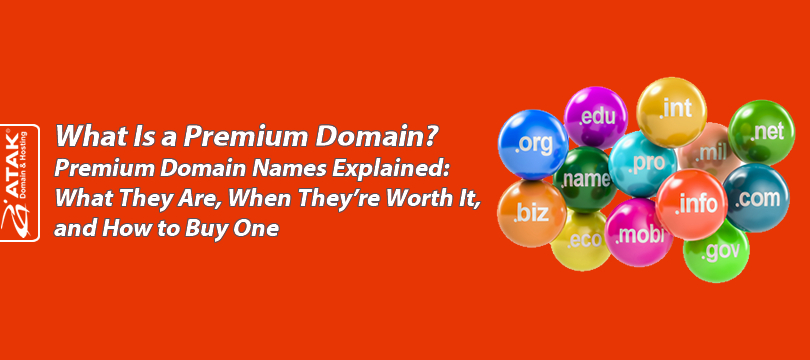
What Is a Premium Domain? Premium Domain Names Explained: What They Are, When They're Worth It, and How to Buy One
Search for a domain name and you'll occasionally see a price that stops you: the name is technically available, but the cost is not $15 — it's $500, $2,000, or more. That's a premium domain. It's not taken. It's not broken. It's just been designated as more valuable than average.

Premium domains are the prime real estate of the internet — short, meaningful addresses that could drive direct navigation traffic, signal authority, or define a category. But not every premium domain is worth the price for every buyer. This guide explains exactly what premium domains are, how pricing works, when they make sense, and how to buy one without getting burned.
>> Search Premium and Standard Domains
Compare standard and premium pricing across all extensions in one search
1. What Is a Premium Domain?
In standard domain registration, everyone pays the same price for any available name in a given extension. It doesn't matter whether you're registering "xyz123.online" or "insurance.online" — same fee.
In premium domain pricing, the registry (the authority that manages a domain extension) designates certain names as having greater commercial value and sets a higher price for them. The logic is straightforward: if "insurance.online" or "cars.co" were available at standard prices, speculators would buy them in bulk and resell them for a profit. Registries pre-empt that arbitrage by pricing those names at market value from day one.
Premium domain = short + meaningful + high search volume. The formula is simple. But the price tag is not always proportional to value for your specific use case. A clear business case is essential before buying.
2. Two Types of Premium Domain

Understanding the difference between these two categories will save you money and prevent surprises.
A. Registry Premium Domains
These are domain names that have never been registered — they're technically available right now. But the registry has designated them as high-value and set a premium price that applies at checkout instead of the standard registration fee.
The critical detail: registry premium domains usually carry elevated annual renewal fees. In many cases the renewal matches the initial registration price. This means a $500 domain costs $500 every year, not just once. Calculate the 5-year and 10-year total cost before committing.
B. Aftermarket (Secondary Market) Domains
These are domain names that someone has already registered and is now selling. They're available through domain marketplaces (Sedo, Afternic, Dan.com, GoDaddy Auctions) or through direct negotiation with the current owner.
Aftermarket domains can cost anywhere from a few hundred to several million dollars. The key difference from registry premium: once you've purchased an aftermarket domain, the annual renewal fee reverts to the standard rate for that extension. The high cost is a one-time acquisition cost — not an ongoing one.
⚠️ Critical Distinction
Registry premium: high registration fee AND high annual renewal — paid every year indefinitely.
Aftermarket premium: high one-time acquisition price, standard annual renewal going forward.
Before purchasing, confirm which type you're dealing with and project the total cost accordingly.
3. Which Extensions Have Premium Domains?

Many popular extensions include premium domain tiers. Each registry maintains its own premium list and pricing structure.
| Extension | Premium Type | Typical Premium Categories |
|---|---|---|
| .com | Mostly aftermarket | Sedo, Afternic, GoDaddy Auctions — previously registered names |
| .io | NIC.IO Registry Premium | Short names, single/two-syllable words |
| .co | .CO Registry Premium | Single-word, short, commercially valuable names |
| .online | Radix Registry Premium | Generic, short, high-search-volume names |
| .ai | Anguilla NIC Premium | Short AI/tech-adjacent names |
| .store | Radix Registry Premium | High-value e-commerce category names |
💡 How Premium Works in .com
For .com, truly new (never-registered) domains almost always use standard pricing.
What most people call "premium .com domains" are previously registered names sold through Sedo, Afternic, GoDaddy Auctions, or directly by the owner.
These are aftermarket transactions — the acquisition price is high, but annual renewal reverts to standard .com rates.
4. Premium vs Standard Domain: At a Glance
| Feature | Standard Domain | Premium Domain |
|---|---|---|
| Registration fee | Standard (e.g. $10–30/year) | High (’100s to ’000s of dollars) |
| Renewal fee | Standard annual renewal | Often elevated; can match or exceed registration |
| Availability | First come, first served | Registry-reserved; special pricing |
| Name length | Typically 3–63 characters | Often 1–8 characters or single common words |
| Search volume | Variable | High; direct navigation potential |
| Brand signal | Moderate | Strong; sector authority signal |
What makes a domain premium is not that it's expensive — it's that the registry or current owner has assessed it as having high commercial value. That assessment is not always correct, and the asking price is not always justified for every buyer. Evaluate on your own terms.
5. How to Buy a Premium Domain

The purchase path depends on whether you're buying a registry premium or an aftermarket name.
Registry Premium: Buying at First Registration
When you search for a domain and it appears available but at a high price, that's a registry premium. The purchase process is identical to standard registration — you just pay more at checkout. Before confirming:
- Check the renewal fee. This is the number that determines long-term affordability. Ask your registrar explicitly, or look for it in the checkout details.
- Project the total cost. Calculate 5 and 10-year total ownership cost. A $300 registration with $300 annual renewal costs $3,300 over 10 years.
- Consider alternatives. The same name in a different extension may be available at standard pricing. "insurance.io" premium vs "insurance.online" standard — evaluate both.
- Test the business case. Could your brand be built just as effectively on a different name? If yes, the premium price may not be justified.
>> Search Premium Domain Prices
See standard and premium pricing across all extensions at Atak Domain
Aftermarket: Buying a Previously Registered Domain
If the domain you want is already registered by someone else, here's how to acquire it:
- ✅ WHOIS lookup — Find the current owner and contact information. Check whether a "domain for sale" note is already present.
- ✅ Domain marketplaces — Sedo, Afternic, Dan.com, GoDaddy Auctions list domains actively for sale. Search there first before reaching out directly.
- ✅ Direct offer — If the domain isn't listed for sale, you can still make a direct offer. Many owners will sell domains they're not actively using.
- ✅ Domain broker — For high-value acquisitions, a professional broker can negotiate on your behalf, often reducing the final price and handling the legal transfer.
- ✅ Secure payment — For significant transactions, use an escrow service (Escrow.com). Never wire funds directly to an unknown party. Escrow holds payment until the domain transfer is confirmed.
- ✅ EPP transfer code — Once purchase is agreed, the seller provides an EPP (auth code) to authorise the transfer. Be aware that a 60-day ICANN transfer lock may apply after the domain moves to your registrar.
6. When Does a Premium Domain Make Sense?
There is no single answer. The value of a premium domain depends entirely on your specific situation.
A premium domain may be worth it when:
- The name exactly defines your industry or service category (insurance.online, legal.co, cars.io) and you're building long-term authority in that space
- Direct navigation traffic potential is high — users type this address without knowing your brand
- Blocking a competitor from acquiring the name is strategically critical
- It's a long-term corporate investment proportional to your marketing and branding budget
- The renewal cost is sustainable and already factored into your plan
A premium domain probably is not worth it when:
- Your brand name doesn't match the generic term — users will search for your brand specifically, not the generic keyword
- Renewal costs strain your budget — project 3-5 year total cost before committing
- You're early-stage — build the brand first; revisit premium domains when you have traction and budget
- The same name is available at standard pricing in a different extension — register that first, evaluate the premium version later
7. What to Check Before Buying
- ✅ Renewal price — The annual renewal fee — not the registration fee — is what determines long-term affordability. Verify it explicitly before purchasing.
- ✅ Domain history — Use DomainTools, the Wayback Machine, or Ahrefs to check what the domain was previously used for. Past spam, adult content, or penalties can affect SEO standing even after a transfer.
- ✅ Trademark conflicts — If the name overlaps with a registered trademark, you may face legal exposure. Research this before buying, especially for generic industry terms.
- ✅ Alternative extensions — Is the same name available at standard pricing in .online, .co, .io, or another extension? Compare before committing to premium pricing.
- ✅ Transfer rules — For aftermarket acquisitions: confirm EPP code process, registrar transfer timeline, and any applicable lock periods. ICANN rules allow a 60-day lock after certain transfers.
- ✅ Payment security — For high-value aftermarket transactions, use Escrow.com or a similar escrow service. Never wire funds directly to an individual seller.
8. Using a Premium and Standard Domain Together
Many brands own both a standard domain and a premium domain. The most common strategy: use the standard (or existing) domain as the primary address, and hold the premium domain for future brand expansion or as a redirect.
- Current primary address: yourbrand.com or yourbrand.online at standard pricing — operational, already building authority
- Strategic premium domain: industry.io or keyword.co — held, redirected to primary, or earmarked for a future product line
- Brand protection: Holding a valuable premium domain before a competitor registers it can be a low-cost insurance policy in the long run
9. Frequently Asked Questions
❓ What is a premium domain name?
A domain name designated by the registry or a current owner as having higher commercial value than average — due to its short length, generic meaning, or high direct-navigation potential. Premium domains carry higher registration prices. Registry premium domains also carry elevated annual renewal fees. Aftermarket premium domains have a high one-time acquisition cost but standard annual renewal going forward.
❓ Are premium domains more expensive to renew?
Registry premium domains: yes, typically. The annual renewal fee is often equal to or higher than the initial registration price, and it applies every year. This is the most important number to verify before purchasing. Aftermarket premium domains: no — once you own the domain, renewal reverts to the standard rate for that extension.
❓ Are premium domains worth it?
It depends on your context. A generic, short domain that directly describes your industry can be worth significant investment if it generates direct navigation traffic, blocks competitors, and supports long-term brand authority. For early-stage brands or when renewal costs are unsustainable, building on a standard address first is often the smarter path.
❓ How do I identify a premium domain?
When searching for a domain, if the available name shows a price significantly higher than standard registration (e.g. $500, $2,000 or more), it's classified as premium. Some registrars label these explicitly as "Premium Domain" at checkout. Always check both the registration price and the annual renewal fee shown.
❓ How do I buy an aftermarket domain?
Search Sedo, Afternic, Dan.com, or GoDaddy Auctions for listed names. For unlisted domains, make a direct offer to the current owner via their WHOIS contact. For significant transactions, use Escrow.com to protect the payment. The seller provides an EPP (auth code) to initiate the transfer, and a 60-day ICANN transfer lock may apply after the move.
❓ Does a premium domain help with SEO?
A premium domain does not guarantee higher search rankings on its own. The real SEO-adjacent value comes from direct navigation traffic (users typing the address directly), brand memorability, and the authority signal a short, generic name can carry. Search engine rankings are determined by content quality, technical SEO, and backlinks — not the domain name itself.
❓ What happens if I can't renew a premium domain?
If you fail to renew a registry premium domain, it will enter a grace period (typically 30 days) followed by a redemption period before being released back into the registry premium pool. Atak Domain removes expired domains from your account on day 20 after expiry. Recovery during the redemption window is possible but costly. Enable auto-renewal as soon as you register any premium domain.
❓ Where can I search for premium domains at Atak Domain?
Search all extensions — standard and premium pricing displayed together — at atakdomain.com/en/domain-name-search. Premium pricing is shown automatically at checkout if the name you've selected is in the premium tier.
The Honest Take on Premium Domains
Premium domains are not a scam and they're not a guaranteed investment. They're a pricing mechanism that reflects perceived market value — and like all markets, that value is subjective and context-dependent.
The right question is not "is this domain worth the price?" — it's "is this domain worth the price for my specific brand, at this stage of growth, with this renewal cost, for this many years?" Answer that question honestly, and the decision becomes clear.
Search Standard and Premium Domains
Search Standard and Premium Domains
Compare pricing across all extensions. Standard and premium prices shown together at checkout.
Categories
- Domain Guide & Registration Process
- Email Services & Setup Instructions
- Step-by-Step How-To Guides
- Insights & Articles from the Tech World
- Server Management & Performance Tips
- Software Development & Coding Resources
- SSL Certificate Guide for Secure Websites
- Choosing the Best Hosting & Optimization Tips
- Key IT Terms & Their Definitions
- SQL Database Management & Queries
- WordPress Setup & Optimization Strategies
Random Articles
Shareaholic Review: A Suite of Audience-Engaging WordPress Tools
16.02.2022
.inc Domains: Your Bridge to International Markets
22.04.2024
10 Tips for Finding the Perfect Small Business Domain Name
31.03.2021
The Rise of Personal Branding: How Unique Domains Can Define Your Online Legacy
25.01.2024
Why should you secure misspellings and alternatives to your domain name
22.04.2021