.dk Domain: Denmark's Official Country Code Extension
.dk is the country code top-level domain of Denmark and entered the root zone on 14 July 1987, which puts it among the oldest country extensions on the internet. The registry is run by Punktum dk A/S, a company that was called DK Hostmaster until 1 May 2023 and is wholly owned by the association DIFO. The mandate is awarded by public tender and supervised by Erhvervsstyrelsen, the Danish Business Authority. The rules are more than a company contract: the framework comes from domæneloven, the Danish Act on Internet Domains of 2014.
On eligibility, .dk keeps the door open: any natural or legal person, Danish or foreign, may register, and there is no requirement for a Danish address, a local representative or a trustee service. What the registry does insist on is identity. Residents of Denmark verify with an electronic ID, everyone else by submitting documentation, and the request has to be answered in time. .co.dk points at the same country but is not the official registry's zone: it is a separate third-level namespace opened by a private operator.
Two details set .dk apart from most extensions. The first is who your contract is with: you register through a registrar, yet the agreement for the domain name is made directly with Punktum dk, and you can manage the name yourself in the registry's self-service. Change provider and the name still stays yours. The second is that your registration data is public, because the law requires your name, address and telephone number to be published. The zone is signed with DNSSEC. Check whether your name is free on the domain name search page.
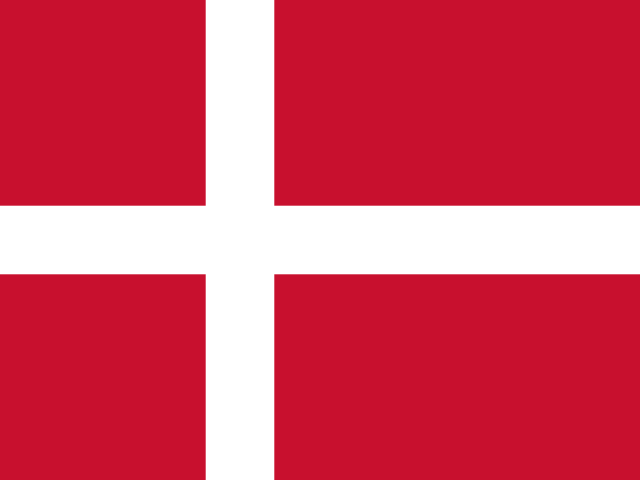
.DK Domain at a Glance
- Registry operator Punktum dk A/S (called DK Hostmaster until 1 May 2023)
- Owner and supervisor The association DIFO; supervised by Erhvervsstyrelsen
- Entered the root zone 14 July 1987
- Names registered 1,300,136 (registry counter, July 2026)
- Window after expiry Thirty days of suspension, then deletion
- Legal framework domæneloven (2014); registry terms version 15
- Document Requirement No documents are required to register a .dk domain
- Country Denmark
- Character Length 3 - 63 characters
- Registration Period 1 years
- Name Server Count 2 - 10 servers
.dk Domain Prices — No Surprise Fees
Registration, transfer and renewal fees are listed separately. The renewal price can differ from the first-year price, so you see both up front.
-
New Registration
$31.99 /year -
Renewal
$39.99 /year -
Restore
$78.92 -
Late Renewal
$7.98
Included With Every .dk Domain
-
Free DNS management
Change A, MX, TXT and CNAME records yourself from the panel — no waiting on anyone when you move a site or mailbox.
-
Domain forwarding
Point the domain at your existing site, a campaign page or a social profile — at no extra cost.
.dk Domain Lifecycle
What happens day by day after it expires
Day 0 is the domain's expiry dateIn short: for .dk the post-expiry timeline is set by the registry, so it differs from one extension to the next. The diagram below shows the windows that actually apply to .dk, day by day. One thing never changes, whichever extension you hold: renewing before the expiry date is always the cheapest and safest route.
Domain Is Available (Available)
A .dk address at this stage has not been taken yet, and it goes to whoever registers first. Check the name you have in mind — if it is free, it can be yours within minutes.
Domain Is Active (Active Period)
Once registration is complete, the domain is registered to you for the term you selected. You can renew at any point before it expires to keep it active, or switch on auto-renewal so you never have to watch the date.
Redemption Period (Redemption Period)
The domain is not released the moment it expires — during this window it is still yours and can be recovered. Some extensions charge an extra restore fee at this stage, so renewing before expiry is always the cheaper route.
Domain Is Available Again
Once deletion completes, the domain leaves the system and anyone can register it — popular names are often taken the same minute by someone watching. Keep auto-renewal on so a name you care about never gets this far.
.dk Domain Specifications and Registration Rules
Registration conditions, supported features and the registry's own timelines in a single table.
.dk Domain Registration
- Document Requirement No documents are required to register a .dk domain
- Country Denmark
- Character Length 3 - 63 characters
- Registration Period 1 years
- Name Server Count 2 - 10 servers
.dk Domain Support
- IDN Support No
- Transfer Support Yes
- Late Renewal Support Yes
Frequently Asked Questions About .dk Domains
The questions people actually ask before registering — answered plainly.
-
No. The Danish registry sets no requirement of nationality, residence or commercial status: any natural or legal person, Danish or foreign, may register. You do not need an address in Denmark, a local representative or a trustee service, and there is no cap on how many names one holder may take. A company based in Türkiye, a sole trader and a private individual all apply on the same terms, with priority decided by order of arrival. The one real gate in this zone is not eligibility but identity: after registration the registry asks you to prove who you are, in order to protect the zone against abuse.
-
Once the registration is complete, the registry asks you to confirm who you are. Registrants living in Denmark do this with an electronic ID; registrants abroad go the documentation route, and papers are accepted in Danish, English or the other languages the registry supports. The registry publishes separate procedures for new and existing registrants, split again by whether they reside in Denmark or outside it. What matters most is the deadline: if the request is not answered in time, the agreement can be terminated. Keep the email address held by the registry working at all times, because the verification request arrives there.
-
Yes, and that is the law rather than a policy choice. The Danish Act on Internet Domains requires the registry's public whois database to hold the registrant's name, address and telephone number, and for companies that are not sole proprietorships the email address appears as a general rule. There is no privacy service to buy. The only exception is private individuals who hold name and address protection in the Danish civil registration system. Billing contact and proxy details stay hidden in every case. You can view the public record of a name on the whois search page.
-
You get thirty days. If the fee for the new period is not paid, the registry suspends the domain name for thirty days; during that window the address will not resolve in practice, but the name is still yours. To bring it back you pay not only the period fee but also a reinstatement fee. When the thirty days run out, the name is deleted. The thirty-day grace plus redemption chain familiar from generic extensions does not exist here: the whole window is thirty days, and after that the loss is final. Keeping the address that receives expiry warnings current is therefore worth the effort.
-
Denmark runs a formal, paid queue for exactly this. The registry operates a waiting list: applicants for a name that is already taken are added in the order their requests reach the registry. When the name is released, the offer to register goes to whoever sits at the top of the list, and that applicant has fourteen days to take it; if they do not, the offer passes to the next in line. A place on the list carries a fee and is renewed annually, and the place is deleted if the fee for the following period goes unpaid. So there is no drop-catching race in .dk, there is a queue.
-
No. The Danish Act on Internet Domains prohibits it outright: registrants may not register and maintain domain names solely for the purpose of resale or leasing. The same section also forbids registering and using domain names contrary to what Danish law calls good domain name practice. What is only a contractual clause in most extensions is written into statute here, and a breach can be taken to the complaints board, which may order the name deleted or transferred. If domain warehousing is the business model you have in mind, this zone is not built for it.
-
ICANN's UDRP does not apply in this zone. Denmark has an independent board created by statute: Klagenævnet for Domænenavne, the Complaints Board for Domain Names. It hears appeals against the registry's decisions as well as disputes between a registrant and third parties over the registration and use of a name. Its remedies are defined: the name may be maintained, deleted, suspended, or transferred to the complainant or to a person the complainant names. It cannot award damages, remuneration or compensation. Anyone with a sufficient interest in the outcome may file, and the board's chairman decides whether that interest is sufficient.
-
Two separate operations are easily confused. A change of registrar changes which company manages the name; your agreement with the registry stays as it is, and since 1 January 2025 the registry charges no fee for the move. A change of registrant is a different procedure and requires the new holder to pass their own identity verification. The reassuring part of the Danish model is that you are not obliged to leave the name in a company's hands at all: you can manage it yourself in the registry's self-service. Start the process on the domain transfer page.
Ready to Claim Your .dk Domain?
Type a name and see in seconds whether it is free on .dk. If it is taken, we list close alternatives right away.
Get Help for .dk Domain Registration
Need help registering a .dk domain? Our team is ready to assist.