Domain Name Expirations: What You Need to Know
26.04.2021
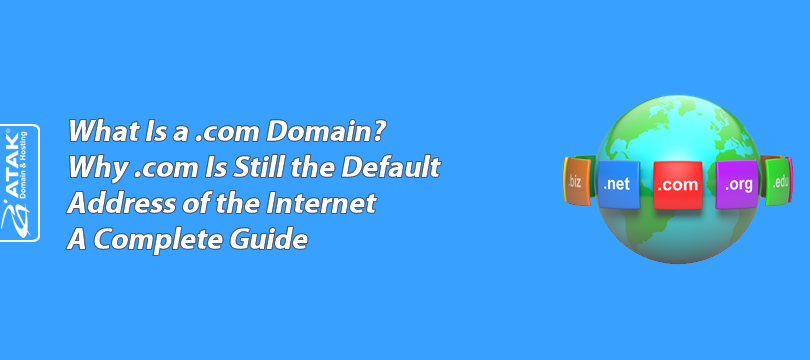
Some things don't change. The internet changed. Technology changed. User behaviour changed. But when someone tells you a website address, the first thing your brain appends is still .com. That's not habit. That's infrastructure.
Hundreds of new domain extensions have launched since 2013. Some of them are excellent choices for specific contexts. But for universal brand recognition, cross-channel marketing, and long-term credibility with the broadest possible audience, .com remains the default. This guide explains what .com is, why it retains its position, when to use it, and how to register one.
$6.99/year · 42% off · 1–10 years · No documents · Real-time activation

.com is a generic top-level domain (gTLD) managed by Verisign Inc., a US-based registry operator. It was one of the original six top-level domains introduced in 1985 and has been continuously operated by Verisign since 1993. There are no restrictions on who can register a .com domain — no documents, no citizenship requirements, no country of residence limitations.
Technically, .com has no special properties. It offers no inherent SEO advantage over other gTLDs, carries no geographic signal, and imposes no obligations on registrants. What makes .com different is entirely perceptual: four decades of global adoption have made it the universal default assumption for any web address.
| Feature | Description |
|---|---|
| ✅ TLD type | Generic Top-Level Domain (gTLD) |
| ✅ Registry | Verisign Inc. (US-based) |
| ✅ Registration period | 1 to 10 years |
| ✅ Eligibility | Open to everyone — no documents, no geographic restrictions |
| ✅ Character length | 3–63 characters |
| ✅ Allowed characters | a–z, 0–9, and hyphens (-). Hyphens cannot appear at the start or end. |
| ✅ IDN support | Supported |
| ✅ DNSSEC | Supported |
| ✅ Transfer | EPP authorization code (auth code) required |
| ✅ Whois privacy | Available as a registrar service |
| ✅ Real-time registration | Yes — domain is active immediately after payment |
| ✅ SEO treatment | Full gTLD — no country-specific geotargeting signal |

Hundreds of new gTLDs have launched. .io has strong tech credibility. .ai is the AI sector standard. .store signals e-commerce intent. Yet .com retains a structural advantage that newer extensions cannot acquire through positioning alone.
When someone hears a brand name and wants to find it, they type the name and append .com without thinking. This is not a preference — it's a cognitive shortcut built over decades. It means that any brand on a non-.com extension faces a consistent risk of losing direct navigation traffic to the .com equivalent, whether that domain is live, parked, or held by someone else.
In a podcast interview, a radio ad, a phone call, or a face-to-face conversation, you can say "brandname.com" and your audience immediately understands. ".io", ".online", or ".store" requires explanation, spelling, or repetition. At scale — across millions of spoken brand interactions — this difference compounds significantly.
.com still functions as an implicit signal of permanence in B2B sales and investor contexts. A pitch deck that lists a .com address and a pitch deck that lists a .co address create slightly different instinctive responses in institutional investors and enterprise procurement teams. The difference is subtle but real, and it operates before anyone evaluates your product.
Users still type URLs directly into browsers. This "type-in traffic" disproportionately favours .com. If your brand name's .com is registered by someone else, a portion of people who intend to reach you will land on that domain instead. This is a permanent, unrecoverable traffic leak as long as the situation persists.
Registering your brand name's .com is less about using it and more about not letting someone else use it. The annual cost of a .com registration is trivially small compared to the cost of acquiring one through an aftermarket transaction, a legal dispute, or a UDRP proceeding.
Simple test: if someone hears your brand name spoken aloud, what do they type into the browser first? If the answer is ".com", you need to own that .com — even if your primary site runs on a different extension.

Straight answer: the .com extension itself is not a ranking signal. Google and all major search engines treat .com, .net, .org, and other gTLDs as equivalent for ranking purposes.
🔍 Expert Note
"If I move to .com, will I rank better?" — No. Changing your extension does not improve SEO. If you're already on .net or .io with established authority, switching to .com for SEO reasons alone introduces migration risk without any direct ranking benefit. Invest in content and backlinks instead.
The right extension depends on your use case, audience, and what signal you want to send before anyone reads your content.
| Extension | Eligibility | Cost | Primary Use |
|---|---|---|---|
| .com | Open to all | $6.99/yr | Universal commercial — any industry, any audience |
| .net | Open to all | Medium | Technical infrastructure, hosting, network services |
| .org | Open to all | Medium | Non-profits, foundations, open-source communities |
| .io | Open to all | High | Software, SaaS, APIs, developer tools |
| .ai | Open to all | Very high | AI-native products and artificial intelligence brands |
| .co | Open to all | Medium | Global startups, company identity, short brand names |
| .online | Open to all | Low | Multi-purpose, globally understood, any sector |
If your ideal .com is taken: try a different word combination or name variation before switching extensions. Most strong brands were built around names that weren't the obvious generic. A distinctive brand on a slightly different .com outperforms a forgettable brand on a "better" extension.
.com is almost always right, but some situations call for additional extensions or different primary choices:
No documents. No eligibility checks. .com registration is real-time — your domain is live immediately after payment completes.
| Step | Title | Description |
|---|---|---|
| 1 | Check availability | Go to the .com registration page and enter the name you want. If it's available at standard pricing, proceed. If it's classified as a premium domain, you'll see the premium price at checkout — check both the registration fee and the annual renewal fee before committing. |
| 2 | Choose your registration period and add-ons | Select 1–10 years. You can add hosting, an SSL certificate, or business email in the same order. Enable auto-renewal immediately — it's the single most important step for protecting a domain you've invested in. |
| 3 | Enter your contact details | Provide accurate name, email, and address. Your registration email is where renewal reminders and account notifications are sent. Use an address you actively monitor. |
| 4 | Complete payment and configure DNS | No document review. Once payment is confirmed, your .com domain is active. From your panel, configure nameservers, set up DNS records (A, CNAME, MX), and enable DNSSEC if your setup supports it. |
$6.99/year · 42% off · No documents · 1–10 years · Real-time activation
"Commercial." .com was introduced in 1985 as one of the original six top-level domains, intended for commercial organisations. Today it is open to everyone worldwide with no restrictions on use. It is managed by Verisign Inc. and is the most registered domain extension in the world.
No. Google treats .com as a standard gTLD on equal terms with .net, .org, and other generic extensions. The extension is not a direct ranking signal. Rankings are determined by content quality, technical implementation, backlinks, and user experience. A .com site with weak content will rank below a .net site with strong content.
No. .com has no eligibility requirements whatsoever. Any individual or business anywhere in the world can register a .com domain immediately, without documents, proof of identity, or any other qualification.
1 to 10 years. Longer registration periods reduce admin overhead and the risk of accidentally letting a domain lapse. Enable auto-renewal regardless of registration length to fully protect the domain.
First, try different word combinations or variations of your brand name. Most strong brands aren't built on generic keywords. If the specific name is essential and you can't find a suitable .com variation, consider .co, .io, or .ai as alternatives. Match the extension to your sector and audience, not just availability.
After expiry, a grace period begins. Atak Domain removes expired domains from your account on day 20 after the expiry date. After that, a redemption period may apply at registry level — recovery is possible but at significantly higher cost than a standard renewal. Enable auto-renewal to avoid this entirely.
Yes. Verisign supports DNSSEC for .com at the registry level. You can enable it through your registrar or DNS management interface. DNSSEC adds cryptographic authentication to DNS records, protecting against spoofing and cache poisoning attacks.
.com is right for commercial brands, global audiences, and long-term brand building. .net suits technical infrastructure, hosting, and network services. .org suits non-profits, foundations, and open-source communities. If budget allows, register all three and redirect two to your primary. See our .com vs .net vs .org guide for a full comparison.
The internet was built around .com. The search engines, the browsers, the users, and the mental models that power billions of daily web interactions were all formed when .com was the only option that mattered. That inheritance is not a technical property — it is collective memory at global scale.
New extensions can carve out valuable niches. But for the broadest possible audience, the longest possible brand lifespan, and the most cost-effective digital asset protection available, .com remains the default choice — and at $6.99 a year, there are very few situations where not owning it makes strategic sense.
$6.99/year · 42% off · No documents · 1–10 years · Real-time activation