Who Hosts This Website? Find the Hosting Provider
27.08.2026
Launching a new company, or trying to strengthen an existing brand's digital identity? Sooner or later you'll hit the same question: which domain extension should you register? .com, your country's ccTLD, or a cheaper new gTLD? This decision matters more than it looks — your extension shapes trust perception, search visibility, and the cost of a future rebrand if you get it wrong.

This guide doesn't just show you current domain market numbers — it turns every number into a decision. As Atak Domain, an ICANN-accredited registrar (IANA ID: 1601), we've handled thousands of domain registrations and transfers over the years. We've built the mistakes and the right calls we see most often from corporate clients directly into this guide, so you shouldn't need another article after this one.
A side-by-side view:
| Extension | Trust | SEO | Brand Perception | Price | Global Fit |
|---|---|---|---|---|---|
| .com | Very High | Neutral / Indirect Positive | Universal, strong | Medium | Very High |
| .co.uk / .us | High (local) | Local Advantage | Local trust | Low-Medium | Single country |
| ccTLD (.de, .fr, etc.) | High (local) | Local Advantage | Local trust | Variable | Single country |
| .ai | Medium-High (niche) | Neutral | Tech/AI signal | High | Medium |
| New gTLD (.xyz, .online) | Low-Medium | Neutral / Caution | Modern but temporary | Very Low | Medium |
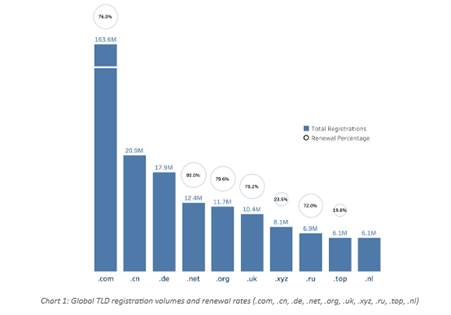
Registration data for the first quarter of 2026 shows the domain market is still shaped by a handful of major players. .com alone holds 163.6 million registrations, followed by .cn (20.9M), .de (17.9M), .net (12.4M) and .org (11.7M). Extensions like .uk, .xyz, .ru, .top and .nl sit in the 6-10 million range.
What this tells you: the domain market never works on a “one extension wins, the rest lose” basis. If you're launching a company today, don't decide purely on the biggest numbers — decide based on where your audience actually is: .com remains the default for a corporate brand, a ccTLD makes more sense if you're entering a local market, and a low-cost new gTLD is fine for an early-stage experiment.
In our experience, roughly a third of corporate clients pick their first domain purely on price and end up rebranding within a few years due to brand-consistency issues. Treating domain choice as a long-term brand investment rather than a line-item cost avoids that costly detour.
163.6 million registrations. That's roughly eight times the size of .cn, the second-largest extension. So why does .com still dominate despite dozens of newer alternatives?
Brand memory: most internet users still add “.com” automatically when picturing a brand in their head. If you're launching a company today, .com should still be your first choice — this habit is exactly what prevents mistyped or misremembered visitors from landing on a competitor's site.
Trust perception: in trust-sensitive sectors like e-commerce and finance, .com still signals corporate legitimacy. Users are more cautious entering payment details on an unfamiliar extension than on a .com.
.com's 76.0% renewal rate shows that most people who register one treat it as a long-term investment — far above many speculative new gTLDs that are rarely renewed.
The rule of thumb for .com vs .net is simple: .net has a solid 80.0% renewal rate, but in the user's mind it's still the “second choice.” We generally recommend .net in two situations: as a temporary fix when your .com is taken, or as a secondary brand-protection domain alongside your main .com — particularly for technical or infrastructure-facing products.
So what should you actually do if your ideal .com is taken? The first instinct is usually to add a hyphen or a number — we don't recommend that, since it increases typo risk and dilutes brand perception. Instead, try these three steps in order:
Check whether the domain is genuinely active. For domains that look dormant or are nearing expiry, a WHOIS lookup will show you ownership and expiry details.
If it's inactive or looks like it might be for sale, consider a domain brokerage service to approach the current owner.
If you need a result quickly, move ahead with .net, your local ccTLD, or a sector-relevant gTLD without distorting the name, and keep the .com under watch for brand-protection purposes.
You can speed this process up with our domain name search tool, which checks the name and all alternative extensions in one pass.
For businesses targeting the UK or US specifically, this is one of the most common real-world questions — and each option serves a different purpose.
.com: the right call if you're building a global brand or expect customers/investors outside the UK or US. Still the strongest option for international brand memory and trust.
.co.uk: ideal for businesses actually trading in the UK. It signals local presence and builds trust with UK consumers and local search results in a way a generic .com sometimes doesn't.
.us: a solid, often cheaper option for businesses explicitly targeting the US market, though in practice .com still carries stronger brand weight for most American consumers.
The most robust approach in practice: anchor your global identity on .com, and register .co.uk or .us defensively (or as an active redirect) to reinforce local trust in that specific market. That way you're visible in both global and local searches, and you protect your brand from extension confusion.
A ccTLD (country code Top-Level Domain) is a domain extension assigned to a specific country or territory — .de (Germany), .uk (United Kingdom), .fr (France), or .com.tr (Turkey), for example. Unlike a global .com, a ccTLD sends a direct message: “this business operates in this country.”
Registration data shows just how strong this segment is: .cn (20.9M), .de (17.9M), .uk (10.4M), .ru (6.9M), .nl (6.1M) and .br (5.6M) all sit near the top of the global rankings. France's .fr has a smaller volume at 4.4M but an exceptionally high 82.1% renewal rate; .eu shows 3.7M registrations with an 81.0% renewal rate.
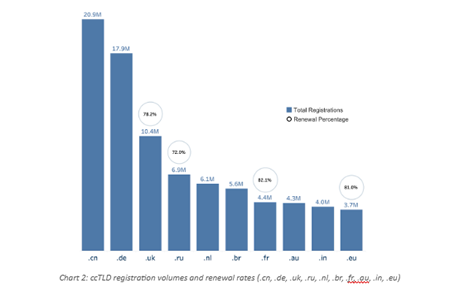
Those high renewal rates on .fr and .eu are a meaningful signal: owners of these domains tend to be serious, long-term operators rather than speculators. If you're planning international expansion, building a dedicated ccTLD strategy for each target market strengthens both brand trust and local SEO performance.
A gTLD (generic Top-Level Domain) isn't tied to any specific country. .com, .net and .org are the “classic” gTLDs; extensions like .xyz, .top, .shop, .online, .store and .site fall under the “new gTLD” category introduced from the mid-2010s onward.
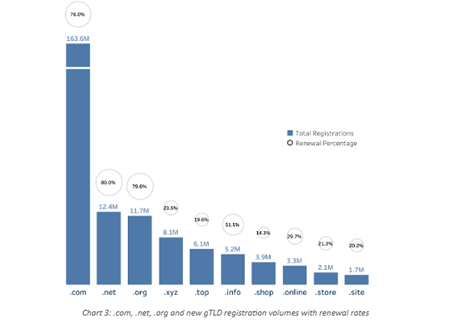
.xyz leads the new gTLD pack at 8.1M registrations, but its renewal rate is only 23.5%. .top follows a similar pattern at 6.1M registrations with a 19.6% renewal rate. .info, at 5.2M, is a more “mature” extension with a comparatively strong 51.5% renewal rate.
The takeaway: many new gTLDs are marketed at very low first-year prices, driving high registration volume, but most owners don't renew once standard pricing kicks in. If you need a fast, low-cost domain for a brand test or campaign, a new gTLD is a reasonable choice — but for a long-term corporate identity, the low renewal rates tell you the market hasn't built the same trust yet that .com or an established ccTLD has.
Registration volume shows you how big an extension is; renewal rate shows you how much real value it holds. Someone paying to keep a domain past its first term is the clearest signal that it carries genuine business or brand value.
Brand inconsistency risk: if the broader trend is moving away from an extension, your brand can start to look dated.
Resale/liquidity risk: for domain investors, a shallow buyer pool on low-renewal extensions increases liquidity risk.
SEO continuity risk: a high abandonment rate across an extension can gradually weaken the overall backlink and authority pool tied to it.
When planning your domain portfolio, weigh the 3-5 year renewal trend of an extension, not just today's price. Extensions with high renewal rates give you a more stable foundation for a long-term corporate identity.
| Industry | Recommended Extension(s) | Why? |
|---|---|---|
| SaaS / Tech | .com, .io, .ai | Investors and developers read .io/.ai as a tech signal; the core identity should still sit on .com. |
| Law Firms | .com, ccTLD of practice (.co.uk, .com.au, etc.) | Trust is critical; exotic extensions can undermine a law firm's credibility. |
| E-commerce | .com, .shop, .store | .com stays the primary address; .shop/.store work well as secondary redirect domains. |
| Healthcare | .com, national ccTLD | Patient trust matters — avoid low-renewal, low-trust extensions for a clinical brand. |
| Non-profits | .org | Signals non-commercial intent directly and builds donor trust internationally. |
| Local Service Businesses | ccTLD (.co.uk, .us, .com.au, etc.) | Gives a real edge in local search results and local consumer trust. |
| Media / Content Sites | .com, .net, .info | High-traffic projects are safer on established extensions for long-term SEO authority. |
Short answer: Google doesn't directly favour any one generic extension. There's no algorithmic priority among .com, .net, .xyz and similar TLDs. But that doesn't mean the extension has zero SEO impact — the effect is indirect but real.
ccTLDs send a strong geo-targeting signal; a .co.uk or .de domain has a real edge in that country's local search results.
Extensions with low renewal rates tend to have higher spam concentrations, which can make search engines treat that extension category more cautiously overall.
Branded search volume (people searching your brand name directly) is an indirect SEO signal, and a familiar, trusted extension supports more of that behaviour.
In practice, Google doesn't “like” an extension — it rewards trustworthy patterns. High renewal rates, low spam density, and correct geo-targeting all indirectly strengthen your SEO performance.
Brand-focused domain strategy works on two layers: your active primary address, and a defensive layer. The primary address should usually be .com or your target market's ccTLD. The defensive layer should cover typo variants of your brand name, your most critical alternative extensions (.net, .org), and the ccTLDs of countries where you operate.
High registration density on popular extensions also creates real brand risk: domain squatting, phishing lookalikes, and counterfeit sites that damage your reputation. An effective brand protection strategy should include:
Defensive registration of your brand on the most critical extensions
Monitoring and registering typo variants where necessary
Tracking domains nearing expiry via backorder services if they're relevant to your brand
Regularly checking ownership records for domains in your portfolio
Our WHOIS Search tool gives you instant ownership and expiry data on any suspicious or target domain, so you can act on brand-abuse risks proactively rather than after the fact.
A growing company rarely needs just one domain. A solid corporate portfolio strategy has at least four layers: your primary brand domain (usually .com), defensive registrations, geographic expansion domains (ccTLDs for each target market), and campaign/project domains (short-term new gTLDs).
Domain transfer usually comes up when you're changing registrars, consolidating a portfolio, or need better management tools. Consider a transfer if your current provider's pricing or support no longer meets your needs, if you want your corporate portfolio in one panel, or as part of a domain acquisition process.
The process is technically simple: unlock the domain, get an authorization (EPP) code from your current registrar, and confirm the transfer request with the new one. It typically completes within a few days, and an extra year is added to the domain term — making transfer a renewal opportunity as well. You can start a transfer any time via our Domain Transfer page.
The rise of AI tools is reshaping domain choice in two ways. AI-assisted brand-naming tools let founders test more name and domain combinations faster, pushing overall registration volume up. At the same time, AI-focused startups have driven intense demand for niche extensions like “.ai” — it's become a genuine brand signal in the tech and AI sector; investors and developers read a .ai address as an automatic positioning cue.
Should you register a .ai domain?
Yes, if you're building an AI, machine learning or automation product — but as a complement to .com, not a replacement for your primary identity.
Does .ai affect SEO?
.ai carries no direct SEO advantage or disadvantage on its own; Google evaluates it like any other gTLD. But if your audience expects to see “.ai” for your category, it can indirectly boost branded search volume and click-through.
| Your Situation | Recommended Extension | Note |
|---|---|---|
| New global brand | .com | First choice whenever the name is available |
| .com is taken, but I don't want to change the name | .net or local ccTLD | Prefer this over adding hyphens/numbers |
| Local business focused on one country | Relevant ccTLD (.co.uk, .us, .de) | Delivers local trust and SEO advantage |
| Non-profit / association | .org | Communicates non-commercial intent directly |
| AI / tech startup | .com + .ai | .com as primary identity, .ai as sector signal |
| Short-term campaign or test | .xyz, .online, .site | Low-cost, shouldn't replace your core identity |
| E-commerce project | .com + .shop/.store (redirect) | .com should remain the primary address |
Yes, total registration volume keeps growing, but not evenly. .com and established ccTLDs show steady growth, while some new gTLDs see registration growth paired with low renewal rates — meaning net growth there is more limited.
Start by defining your target geography, then pick a short, memorable name that fits your brand. Go with .com for a global audience, a ccTLD for a local market, and a low-cost new gTLD for a short-term project.
.com wins on brand memory and trust. .net works well as a temporary fallback when .com is taken, or as a secondary domain for a technical/infrastructure-facing product.
First check via WHOIS whether it's genuinely active. If it's dormant or looks available for sale, consider a brokerage service. If you need a fast result, go with .net or your local ccTLD without distorting the name.
Choose .com if you're building a global brand or expect international customers. Choose .co.uk or .us if you're specifically targeting that market and want strong local trust and search relevance.
A ccTLD (country code Top-Level Domain) is a two-letter extension assigned to a specific country or territory — examples include .de, .uk, .fr, and .us.
A gTLD (generic Top-Level Domain) isn't tied to a specific country. .com, .net and .org are classic gTLDs; .xyz, .shop and .online are “new gTLDs.”
Not directly, but yes indirectly. ccTLDs help with geo-targeting, while extensions with high spam concentration (often low-renewal gTLDs) can face more cautious treatment from search engines overall.
It's worth considering if you're changing registrars, consolidating your portfolio, or need better management tools. The process starts with unlocking the domain and getting an EPP authorization code.
.ai has become a strong brand signal in the AI sector; investors and developers read it as an automatic positioning cue toward artificial intelligence.
It's the centralized management of a company's entire domain portfolio — renewal dates, DNS settings, and ownership records — through a single professional dashboard, which significantly reduces operational risk for large portfolios.
The domain market isn't a single-dimension space: .com's dominance continues, ccTLDs are gaining ground through local trust and geo-targeted SEO, and new gTLDs remain a flexible but comparatively short-lived, low-cost segment. The right strategy for your business comes down to a layered portfolio approach that matches your target markets and long-term growth plans.
Once your domain is registered, the next step is usually getting your website live and reinforcing brand trust.
To secure your site, take a look at our SSL Certificate options, and for hosting your site, explore our Web Hosting plans.
The most trustworthy domain extensions: .com, .net, .org and strong ccTLDs (.co.uk, .us, .de).
New gTLDs suit campaigns and test projects, not your core corporate identity.
The right corporate strategy: primary .com + defensive registrations + ccTLDs for each target market.