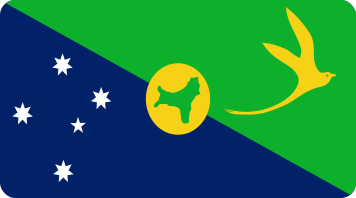
.cx Domain: Christmas Island's Official Country Extension
.cx is the country code top-level domain of Christmas Island, an Australian territory in the Indian Ocean, and it entered the root zone on 24 April 1997. Although the island is governed from Australia, the extension has its own registry: names are administered by Christmas Island Domain Administration Limited (cxDA), a not-for-profit body established in 2000 and controlled by its members. Day-to-day technical operation has been contracted to CoCCA Registry Services in New Zealand since 2016. cxDA accepts no applications directly, so you register through an accredited registrar.
On eligibility, .cx keeps almost no gate closed. The registrant agreement asks for one qualification only: the applicant must be either an identifiable individual over eighteen or a legally recognised entity. There is no requirement to reside on the island or in Australia, no local address, no local contact, no trustee and no paperwork to file; a company or a sole trader applying from abroad registers on exactly the same terms. Priority goes to whoever applies first, and the term is chosen in one-year steps from one year up to ten.
Two details shape day-to-day use here. The first is how far the rules reach: the cxDA acceptable use policy applies recursively, so any sub-domain you create under your own name falls under the same obligations you accepted. The second is what follows expiry — a lapsed name first drops into a recovery window, and once that window closes it is purged within seven days and opens to anyone, which leaves little room to fix a late renewal. Check whether your name is free on the .cx domain registration page.
.CX Domain at a Glance
- Administering authority Christmas Island Domain Administration Limited (cxDA)
- Technical registry operator CoCCA Registry Services (NZ) Limited, since 2016
- Entered the root zone 24 April 1997
- Names registered About 14,000 (the registry's own statement)
- Complaint procedure CoCCA Complaint Resolution Service — UDRP does not apply
- Governing law Australian law, with the Australian courts as venue
- Document Requirement There are no requirements for buying .cx domain registration
- Country Christmas Island
- Character Length 3 - 63 characters
- Registration Period 1 - 10 years
- Name Server Count 2 - 10 servers
.cx Domain Prices — No Surprise Fees
Registration, transfer and renewal fees are listed separately. The renewal price can differ from the first-year price, so you see both up front.
-
New Registration
$69.99 / years -
Transfer
$69.99 / years -
Renewal
$76.99 / years -
Restore
$136.00 -
Late Renewal
$15.40
Included With Every .cx Domain
-
Free DNS management
Change A, MX, TXT and CNAME records yourself from the panel — no waiting on anyone when you move a site or mailbox.
-
Domain lock
While the lock is on, nobody can move your domain to another registrar without your approval.
-
Domain forwarding
Point the domain at your existing site, a campaign page or a social profile — at no extra cost.
-
Free WHOIS privacy
Your name, address and phone stay out of public WHOIS records, which cuts down spam and scam calls.
.cx Domain Lifecycle
Domain lifecycle
The stages in order, from registration to releaseDomain Is Available (Available)
A .cx address at this stage has not been taken yet, and it goes to whoever registers first. Check the name you have in mind — if it is free, it can be yours within minutes.
Domain Is Active (Active Period)
Once registration is complete the domain is yours for the term you chose. You can renew at any point before expiry to keep it uninterrupted, or switch on auto-renewal so you never have to watch the date.
Redemption Period (Redemption Period)
The domain is not released the moment it expires — during this window it is still yours and can be recovered. Some extensions charge an extra restore fee at this stage, so renewing before expiry is always the cheaper route.
Pending Delete Period (Pending Delete Period)
If the redemption window is missed too, the domain enters the final stage and waits to be deleted. Renewal and recovery are no longer possible here; when the period ends the registration is removed for good.
Domain Is Available Again
Once deletion completes, the domain leaves the system and anyone can register it — popular names are often taken the same minute by someone watching. Keep auto-renewal on so a name you care about never gets this far.
.cx Domain Specifications and Registration Rules
Registration conditions, supported features and the registry's own timelines in a single table.
.cx Domain Registration
- Document Requirement There are no requirements for buying .cx domain registration
- Country Christmas Island
- Character Length 3 - 63 characters
- Registration Period 1 - 10 years
- Name Server Count 2 - 10 servers
.cx Domain Support
- IDN Support No
- Transfer Support Yes
- Late Renewal Support Yes
.cx Domain Registration Periods
- Registration Periods 1,2,3,4,5,6,7,8,9,10 years
- Renewal Periods 1,2,3,4,5,6,7,8,9 years
- Pre-registration 1 days
- Accounting Period 45 days
- Finalization Period 1 days
- Failure Period 45 days
- Payment Period 45 days
- Redemption Period 30 days
- Deletion Hold Period 30 days
- Renewal Time 30 Day
Frequently Asked Questions About .cx Domains
The questions people actually ask before registering — answered plainly.
-
No. The registrant agreement asks for one qualification and no more: the applicant must be either an identifiable individual over eighteen or a legally recognised entity such as a company, partnership, association or society. Residence on the island or in Australia, a local address, a local contact, a trustee, supporting documents — none of these appear anywhere in the text. A company registered abroad, a sole trader and a private person all apply on the same terms. Priority is purely chronological, and the agreement states plainly that no name is guaranteed. You cannot register with the registry directly; you go through an accredited registrar.
-
From one year to ten, in one-year steps. The registry's back-end agreement states that initial registrations may be made in one-year increments up to a maximum of ten years and repeats for the avoidance of doubt that ten years may not be exceeded. Renewal works the same way, with one important twist: a renewal may not extend the registration beyond ten years measured from the moment of renewal, not from the current expiry date. Every intermediate term is valid, so two, three, five or seven years are all possible. Longer terms simply reduce how often you have to watch the expiry date.
-
The name is not gone at once, but the window is narrow. After expiry the registration first drops into a recovery period: the domain stops resolving, the registry reports it with the redemptionPeriod status, and only the holder can bring it back. The registry publishes two separate dates for this, the end of the recovery window and the purge date, and on the records measured the purge falls exactly seven days after the recovery window closes. Once purged, the name is open to anyone and the former holder gets no priority. In short: recovery exists, but you may have days rather than weeks.
-
Through the standard EPP procedure. The registry follows the EPP protocol used across the industry for transfers: you request the authorisation code from your current registrar, hand it to the new provider, and the registry records the change as a transfer event on the domain. The one thing that stops a transfer is a lock — many .cx registrations carry the clientTransferProhibited status, and nothing starts until your current provider lifts it, so that is the first step. Keeping your contact details current matters here too, because the code goes to the address on file. Begin on the domain transfer page.
-
Usually not. The registry's privacy policy is built on data minimisation: only the registrant's own contact record is compulsory, while administrative, technical and billing contacts are optional. The same policy says the European standard of protection is applied when personal data is disclosed through any registry interface, and that this protection is offered to every user regardless of where they are. In a measurement taken in August 2026 the large majority of records printed no holder block at all — only the name, the dates, the status codes, the name servers and the registrar's details. Check your own record on the whois search page.
-
Not through UDRP, but through CoCCA's Complaint Resolution Service. The procedure has three tiers. First the registry receives a signed complaint form and reviews whether the domain should be suspended to protect the public interest. The file then goes to an ombudsman for mediation, with all correspondence kept confidential; lodging the complaint and the mediation itself are free of charge. If no amicable outcome is reached, the case passes to an expert who issues a binding decision, and that stage is chargeable. The registry implements whatever the decision requires, and the parties may still go to court.
-
Yes. The zone itself is signed: a DS record for .cx is published in the root and validating resolvers mark the answers as authenticated. The registrant-facing side works too — the registry publishes the DS records submitted through your registrar, showing a delegationSigned flag together with the key details in its lookup responses. So you can sign your own domain and make it verifiable end to end. Adoption, however, is still thin: almost every record sampled in August 2026 was unsigned. Enabling DNSSEC goes through your registrar, because the registry accepts no requests directly from holders.
-
The extension is administered by Christmas Island Domain Administration Limited, known as cxDA and established on the island itself. It is a not-for-profit body controlled by its members, and by its own description it holds the extension in trust for the Christmas Island community; its officers are volunteers and it publishes its financial statements. Day-to-day technical operation is contracted out to a separate company, CoCCA Registry Services in New Zealand, which does not move the legal authority. Because the island is an Australian territory, the registrant agreement is governed by Australian law with the Australian courts as the venue. Ask us anything on the contact page.
Get Help for .cx Domain Registration
We are here for you at any time you need!