
What Is a Reseller? How to Start a Domain and Hosting Reseller Business (2026 Guide)
03.08.2026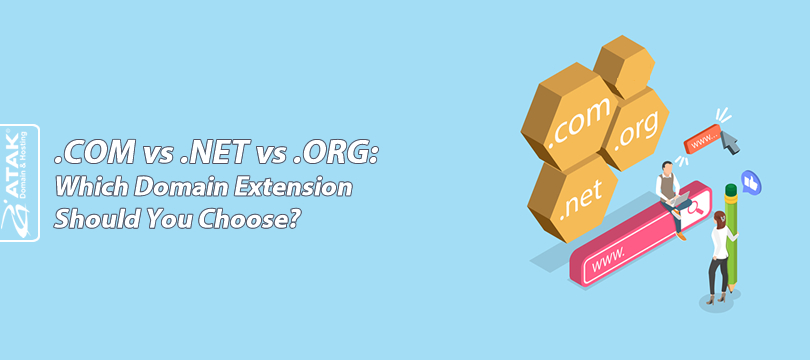
📋 Quick Answer: Which One Should You Choose?
.com — For commercial businesses, e-commerce, and global brands. If a short, clean .com is available, it's almost always the right choice.
.net — For technical infrastructure, hosting, internet services, or as a credible fallback if your ideal .com is taken.
.org — For non-profits, NGOs, foundations, open-source projects, and communities where trust and transparency matter.
All three: open to everyone, no documents required, 1-10 year registration, DNSSEC supported.
The difference is not technical — it's perceptual and strategic.
Your domain extension is the first thing a visitor sees — before your headline, before your logo, before a single word of copy. Those three letters after the dot set an expectation. .com says "business." .net says "technical." .org says "cause." And once that expectation is set, your content either confirms it or fights against it.
Here's the truth: technically, .com, .net, and .org are identical. Same infrastructure. Same SEO treatment. Same registration process. The difference is entirely about perception, audience expectation, and brand strategy. This guide gives you the framework to make the right call.
No documents required · 1–10 years · Register in minutes

Before getting into strategy, here's what you need to know technically. Spoiler: there's almost no difference.
| Feature | .com | .net | .org |
|---|---|---|---|
| Full name | Commercial | Network | Organization |
| Registry | Verisign | Verisign | Public Interest Registry (PIR) |
| Registration period | 1–10 years | 1–10 years | 1–10 years |
| Eligibility | Open to everyone | Open to everyone | Open to everyone |
| Documents required | None | None | None |
| DNSSEC | Supported | Supported | Supported |
| IDN support | Yes | Yes | Yes |
| Character length | 3–63 | 3–63 | 3–63 |
| Primary association | Commercial / brand | Technical / infrastructure | Non-profit / community |
| Global recognition | Highest | Moderate | High (for non-profits) |
| SEO treatment | Equal gTLD | Equal gTLD | Equal gTLD |
Both .com and .net are managed by Verisign. .org is managed by Public Interest Registry (PIR). All three are generic top-level domains (gTLDs). None of them carries a country-specific geotargeting signal. None has any technical advantage over the others in search engine ranking. The choice is entirely about strategy.
.com stands for "commercial" and has been in use since 1985. With over 190 million registered .com domains globally, it is by a significant margin the most recognised domain extension in the world.
Universal recognition: When people hear a brand name and want to find it online, .com is what they type first. This default behaviour is especially powerful in voice, spoken communication, and any context where you can't show the URL visually.
Trust signal: Studies consistently show that .com domains generate higher click-through rates and conversion trust than alternatives. The familiarity alone creates a perception of legitimacy.
Brand protection: Not owning your .com leaves it available for competitors, squatters, or third parties to register. Recovering a .com that someone else holds is expensive and slow.
Investment value: Short, memorable .com names carry real asset value. Good .com domains appreciate on the aftermarket in a way that .net and .org names typically do not.
Availability: Most short, meaningful .com names are taken. Three-to-five-character .com domains with any recognisable word are almost certainly already registered, often by someone who's not using them.
Premium pricing: Short and generic .com names on the aftermarket can cost hundreds of thousands of dollars. Standard registration is cheap; acquiring a taken .com is not.
If your .com is taken: try a different word combination before settling for another extension. Many strong brands were built around names that weren't the obvious generic — they just owned that name completely. A strong brand on a slightly different .com beats a forgettable brand on a premium generic .com.

.net stands for "network" and shares both its registry (Verisign) and its 1985 origin with .com. It was originally intended for network infrastructure organisations — internet service providers, backbone operators, technical intermediaries.
Today .net is open to anyone. But the perceptual association has stuck: a .net domain signals that your product is technical in nature. For the right use cases, that association is an asset, not a compromise.
Hosting and infrastructure services: A company selling servers, bandwidth, DNS services, or cloud infrastructure sounds more native on .net than .com.
Network-facing software: Monitoring tools, VPNs, CDN services, API gateways — .net reinforces what these products do.
Strong .com fallback: .net is the most credible alternative when your brand name's .com is taken. It outperforms .biz, .info, or most new gTLDs in terms of user trust and recognition.
Availability: A significantly higher proportion of desirable names are still available in .net compared to .com.
Typed-in traffic goes to .com: Users who know your brand may habitually type .com. Register the .com version too and redirect it — or accept that you'll lose some direct navigation traffic.
Lower spontaneous trust than .com: For consumer-facing brands or e-commerce, .com still outperforms .net in user familiarity. .net is stronger in B2B and technical contexts.
Technical infrastructure, hosting, and network services · Register now
.org stands for "organization." Its registry, Public Interest Registry (PIR), was created specifically to manage this extension. .org has been in use since 1985 and was originally conceived for non-commercial organisations.
Technically open to anyone, .org has preserved its original identity remarkably well. When users see a .org address, they expect a mission-driven organisation, a cause, a community, or an open resource. That expectation is powerful — and for the right organisations, it's a significant trust advantage.
Non-profits and charities: .org is the standard for organisations seeking donations, volunteers, or community engagement. Users are more likely to trust a charity's .org address than a .com — the extension signals that profit is not the primary motive.
Open-source projects: Wikipedia (wikipedia.org), Linux (linux.org), Mozilla (mozilla.org), and countless other foundational open-source projects use .org. For software communities, .org is the recognised convention.
Research and education: Journals, research institutes, professional associations, and educational resources that aren't eligible for .edu benefit from the credibility signal .org provides.
Advocacy and campaigning: Political campaigns, advocacy groups, and issue-focused communities find that .org aligns with their non-commercial positioning.
Commercial brands: A for-profit business on .org creates a mismatch between address and expectation. Visitors may wonder whether you're a charity, confused about what you sell, or suspicious of the inconsistency.
E-commerce: A shopping site on .org will likely face higher user hesitation at checkout than the same site on .com. The association with non-profit can raise questions about legitimacy for commercial transactions.
Non-profits, foundations, open-source projects, and communities

Short answer: no. Google and all major search engines treat .com, .net, and .org as equivalent generic top-level domains. The extension itself is not a ranking signal.
No geotargeting: None of the three is a ccTLD. None automatically associates your site with a specific country. All three can serve a global audience without any special Search Console configuration.
No ranking advantage: A .net site with excellent content, strong backlinks, and good technical foundations will outrank a .com site with weak content. The extension does not create a shortcut.
Domain age matters more than extension: An older domain with accumulated authority will typically outperform a new domain regardless of extension. This is why switching extensions carries risk — you reset the clock.
Indirect effects through user behaviour: .com may generate slightly higher click-through rates in search results due to familiarity. This indirect signal can affect rankings over time, but it's a secondary effect, not a direct one.
If you're migrating: Moving from .com to .net or .org (or vice versa) is a full site migration. Implement permanent 301 redirects on every URL, re-verify in Google Search Console, and monitor for 6–12 weeks. Permanent 301 redirects help preserve search visibility while search engines process the migration.
🔍 Expert Note
"If I switch to .com will I rank better?" — No. If you're already on .net or .org with established authority, switching to .com for SEO reasons alone is not justified. The migration risk outweighs any perceived benefit. Focus on content, backlinks, and technical SEO instead.
Use this table as a starting point. The final answer always comes back to your specific audience, your brand name availability, and whether the extension matches what your visitors already expect.
| Use Case | First Choice | Alternative | Note |
|---|---|---|---|
| Commercial business / e-commerce | .com | .net or .co if .com taken | .com is almost always right here |
| Tech infrastructure / hosting / SaaS | .net | .com or .io | .net signals technical credibility |
| Non-profit / NGO / foundation | .org | .com if audience expects it | .org builds immediate trust with donors |
| Open-source project / community | .org | .io or .com | Wikipedia, Linux — .org is the standard |
| Personal brand / freelancer | .com | .me, .io or .co | Short .com is the strongest personal asset |
| Startup / developer product | .io or .com | .co or .ai | .io = technical credibility; .com = global |
| Education / research institution | .edu (else .org) | .com or .org | For general international use, .org works |
The strongest strategy: register all three if budget allows. Use one as your primary address and redirect the others. Annual cost for three registrations is minimal compared to the brand protection value. Your .com is the digital equivalent of locking your front door.
No. Google and other search engines treat all three as equivalent generic top-level domains (gTLDs). The extension is not a direct ranking signal. Rankings are determined by content quality, backlinks, technical implementation, and domain authority — not the extension.
No. All three extensions — .com, .net, and .org — are open to anyone worldwide without eligibility requirements or documentation. Despite .org's non-profit association, it is not restricted to non-profit organisations.
.net is the strongest alternative for technical or infrastructure products. For consumer brands and e-commerce, consider .co or a different word combination before settling for .net. .org is appropriate only if your brand genuinely fits the non-profit or community identity — using it for a commercial brand creates expectation mismatch.
Technically yes — .org has no restrictions. But strategically, it creates friction. Visitors expect .org to indicate a non-profit or community organisation. A commercial business on .org can face questions about its legitimacy, especially at purchase decision points.
If your brand name is valuable, yes. Register the primary extension you'll use, plus the other two as redirects. The combined annual cost is small. The cost of recovering a domain that a competitor or squatter has registered is not. Think of it as brand insurance.
1 to 10 years. Longer registration periods reduce the risk of accidental expiry and signal commitment if the domain is associated with a long-term brand. Enable auto-renewal regardless of registration length.
After expiry, a grace period begins. Atak Domain removes expired domains from your account on day 20 after the expiry date. After deletion at registrar level, a redemption window may apply at registry level — recovery is possible but at significantly higher cost than standard renewal. Enable auto-renewal to prevent this entirely.
.com has the highest generic brand value because of universal recognition and direct navigation behaviour. .org has strong brand value specifically for non-profits and community organisations. .net has strong brand value in technical and infrastructure contexts. The best brand value comes from owning the right extension for your category, not the most prestigious one.
You've read the whole guide. Here's what it comes down to:
You're building a commercial brand: get .com first, every time. If your .com is gone, try a different name before you try a different extension.
You're building a technical product or infrastructure service: .net is a credible, meaningful choice — not a consolation prize.
You're building a community, cause, or open-source project: .org signals exactly what you are before anyone reads a word of your site.
You have the budget: register all three. Redirect two of them to your primary domain. Protect what you've built.